The Gut-Heart Connection: How Your Microbiome Impacts Cardiovascular Health
For generations, wise aunties and grandmothers have advised that the quickest path to the heart is through the stomach. Our elders also encouraged us to trust our guts when it comes to matters of the heart. And they may be onto something. A growing body of research shows that the gut is not only a proverbial home to romantic feelings, but also a key player in cardiovascular health.
Many heart-related health factors appear to be influenced by the gut microbiome, including blood pressure, body weight, inflammation, and diabetes. Research on the so-called “gut-heart axis” – a bidirectional communication link between the gut and the heart – may provide new ground for the treatment and prevention of cardiovascular diseases (CVDs), like atherosclerosis (a condition caused by plaque build-up in the arteries that can lead to heart attacks and strokes).
The Alarming Statistics of Cardiovascular Disease
Despite ongoing advances in medicine and therapeutics, CVD incidence remains high, particularly in high- and intermediate-income countries. According to the World Health Organization (WHO), CVDs accounted for 32% of all global deaths in 2022 (a loss of 19.8 million lives). Notably, 85% of CVD deaths are caused by heart attacks and strokes, and 1/3 of these deaths occur prematurely in people under 70 years of age.
The Microbiome’s Role in Atherosclerosis
A direct link between microbiota and atherosclerosis was discovered through early sequencing studies that showed DNA from oral cavity bacteria was present within atherosclerotic plaque. Research has also shown an association between an altered gut microbial community and disease severity. Increased Enterobacteriaceae is associated with higher severity coronary atherosclerosis and larger coronary plaques. Furthermore, patients with chronic heart failure exhibit decreased beneficial bacteria and increased pathogenic bacteria, including Campylobacter, Salmonella, Shigella and Candida species.
Gut microbes affect the risk of developing CVD via the production of various chemicals that influence the atherosclerotic process. The identification of gut microbiota signatures and related metabolites can provide useful information for future clinical interventions. Specific metabolites generated by diverse bacterial species play a role in boosting heart health, as well as determining the onset and progression of cardiovascular and non-cardiovascular pathologies (e.g., colon cancer, kidney disease, Alzheimer’s disease).
Short-Chain Fatty Acids (SCFAs): Heart-Healthy Compounds
Short-chain fatty acids (SCFAs) like acetate, butyrate, and propionate are derived from intestinal bacterial fermentation of polysaccharides that are indigestible to the host. SCFAs promote intestinal barrier integrity, exhibit anti-tumorigenic activity, decrease oxidative stress, regulate lipid metabolism, and modulate inflammation.
Butyrate and acetate help protect the heart by modulating inflammation through inhibition of histone deacetylases (HDACs), which are associated with arterial hypertension and hypertrophy. The role of HDACs is to open or close DNA strands for transcription factors, thereby regulating cellular proliferation for healthy function. During periods of inflammation and stress, pro-inflammatory cytokines increase the levels of HDACs. Chronic inflammation and hypertension keep this process “switched on,” contributing to hypertrophy – increased thickness and reduced muscle contractility – putting further strain on the system.
The inhibition of HDAC leads to positive downstream effects, including the suppression of pro-inflammatory cytokines (e.g., TNF-α, IL-12 and IFN-γ) and increased production of IL-10, an important anti-inflammatory cytokine. Propionate moderately reduces blood pressure through vasodilation. Finally, SCFAs are also involved in reducing intestinal cholesterol availability by converting it to coprostanol, which can then be excreted from the body.
The Dark Side: TMAO and Cardiovascular Risk
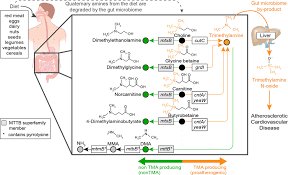
Not all gut microbiota products are beneficial to the host. Trimethylamine N-oxide (TMAO) is generated by bacteria following ingestion of foods containing choline, phosphatidylcholine, and carnitine (e.g., meat, egg yolk, and high-fat dairy products). Researchers continue to uncover potential causal links between this bacterial metabolite and CVD. Increased TMAO plasma levels are linked to a 74% risk of major adverse cardiac events and a 66% increase in all-cause mortality.
TMAO contributes to vascular inflammation by recruiting leukocytes and increasing expression of pro-inflammatory cytokines, leading to vascular dysfunction and plaque formation. Further, TMAO can cause the repositioning of proteins that help maintain the normal structure of T-tubules (invaginations of the heart muscle cell membrane that regulate and synchronize heart cell expansion and contraction).
Nurturing the Gut-Heart Connection: Probiotics and Prebiotics
Regulating the production of TMAO and its associated microbiota may be a promising strategy for the treatment and prevention of atherosclerosis, heart failure, hypertension, and other cardiovascular diseases. This raises an important question: how do we maintain a healthy relationship between our gut and our heart?
The interconnected nature of the relationship between the gut microbiome and the heart suggests that prebiotics and probiotics could be successfully used to target the gut microbiota and its metabolites to manage health. The Food and Agricultural Organization and the WHO define probiotics as “live microorganisms that confer a health benefit on the host when administered in adequate amounts.”
Increasing evidence supports the likelihood that probiotics can alleviate disorders related to the immune system, depression, anxiety, Type 2 diabetes, obesity, and gastrointestinal and cardiovascular health. Lactobacillus (L.) and Bifidobacterium (B.) are 2 of the most used probiotic bacteria. Probiotic bacteria in dairy products, like milk, yogurt, and cheese, can produce bioactive peptides with antihypertensive function. L. helveticus has been shown to produce angiotensin-converting enzyme (ACE) inhibitory tripeptides, which play a role in reducing blood pressure.
One recent clinical trial investigated the potential benefit of introducing the probiotic strain, B. lactis Probio-M8, in alleviating CVD when taken along with a conventional statin regimen. Sixty patients with coronary artery disease were randomly divided into a probiotic group and a placebo group. While both groups showed improvement in heart health, the probiotic group showed significantly more improvement in key cardiac metrics, including serum low-density lipoprotein cholesterol and patient-reported measurements of physical limitation and disease perception, among other factors. Additionally, the probiotic group demonstrated improved levels of anxiety and depression.
It is important to remember that the benefits of probiotics and prebiotics are not immediate and have a greater impact when maintained over a long period. While short-term dramatic dietary interventions are capable of quickly altering a person’s gut microbiome, these changes are temporary. Thus, dietary changes must be maintained to cultivate a healthy microbiome relationship.
Diet and the Gut-Heart Axis
Eating a “colorful diet” rich in plants and containing pre- and probiotics can reduce the risk of cardiovascular disease. A plant-rich diet can encourage the growth of bacterial species that ferment fibers and can result in increased production of SCFAs and other beneficial byproducts. A high-fat diet can result in changes associated with adverse health effects, because in the long term they lead to increased risk of obesity, metabolic syndrome, and cardiovascular problems.
Researchers are just beginning to scratch the surface of the gut-heart axis. New connections between the microbiome and human health are continually being discovered. Dysbiosis has been linked to autoimmune disorders, cancer, obesity, and even psychiatric illnesses. However, most research is observational, and this limits the ability for researchers to determine causality between dysbiosis and disease states. As a newer field of research, clinical data are still somewhat limited, and person-to-person variability causes difficulty in determining treatment efficacy. Additionally, much of the current research focuses on bacteria while neglecting other constituents of the microbiome like viruses, archaea, and fungi.
In the future, clinicians may be able to analyze an individual’s microbiota to determine risk for adverse cardiovascular events. One study demonstrated that the bacterial metabolite succinate was useful as a differential diagnostic tool to distinguish aortic aneurysms and pulmonary embolisms in the emergency department for patients complaining of chest pain. However, there is still much research to be done before widespread use of microbial products in clinical settings is possible. So, until then, listen to Nana!
Source: Image: Canva via ASM staff. Information: Nebraskamed.com