Pat Summitt: A Legacy Beyond the Court
In the world of college basketball, a coach’s emotional outburst often receives a level of grace rarely afforded to others in similar public displays. While witnessing a grown adult throwing a tantrum is generally embarrassing, the context of college sports can sometimes offer a different perspective. However, this leniency doesn’t necessarily excuse the behavior, and often reveals underlying issues of control and respect.
The Spectacle of Coaching Meltdowns
Consider the passionate displays of coaches like Tom Izzo, Mick Cronin, or Dan Hurley. While some might interpret their intensity as a sign of deep care for their players and the game, others see it as a reflection of something less admirable. Over time, these coaches often become caricatures, their personalities amplified by the pressures and expectations of the sport.
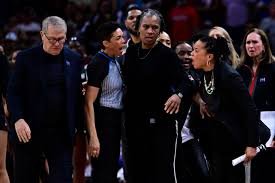
The recent upset loss of UConn to South Carolina in the women’s Final Four brought this dynamic into sharp focus. Geno Auriemma, a coaching icon, responded with visible frustration, a reaction that, while perhaps understandable given the circumstances – ending a perfect season and a 54-game winning streak – was also characteristic of his personality. Auriemma is known for being Auriemma, and his reaction, while surprising to some, wasn’t entirely unexpected.
UConn’s Dominance and South Carolina’s Triumph
UConn had enjoyed a season of unparalleled dominance, boasting a 38-0 record and consistently overwhelming their opponents. Victories came with ease, even by the standards of a program as successful as UConn. Their margin of victory in many games was staggering, leading to concerns about the mental toll it was taking on opposing coaches.
However, South Carolina proved to be a formidable opponent, dominating UConn in a 62-48 victory. The Gamecocks’ aggressive defense stifled UConn’s offense, holding All-Americans Azzi Fudd and Sarah Strong to a combined 20 points on 31 shots. Coach Dawn Staley emphasized their strategy: “Our whole objective was to get them to shoot as inefficiently as possible, make them put the ball on the floor. Don’t give them as many catch-and-shoot opportunities.”
Auriemma’s Post-Game Reaction
Auriemma’s frustration boiled over after the game, focusing particularly on the disparity in free throws (22 for South Carolina, 6 for UConn). While this was a valid point of contention, it was overshadowed by his overall demeanor and interactions with Staley, including a refusal to shake her hand. He voiced his displeasure over Staley not meeting him at halfcourt for a pre-game handshake, a gesture he felt was customary.
Auriemma’s outburst culminated in a press conference filled with frustration and accusations of a double standard, claiming some coaches are allowed to interact with officials in ways others are not. Ultimately, Auriemma issued an apology, acknowledging his behavior was uncharacteristic and did not meet the standards of the UConn program.
The Larger Context of Coaching Meltdowns
While Auriemma’s reaction drew criticism, it also highlighted a broader issue: the pressure and intensity of college basketball often lead to emotional outbursts. These moments, while often regrettable, are a reminder that coaches are human, and subject to the same frustrations and emotions as anyone else. However, they also serve as a reminder of the importance of sportsmanship and respect.
Ultimately, the focus should remain on the game itself. As both Staley and Auriemma acknowledged, their post-game drama risked overshadowing the remarkable achievement of South Carolina’s victory. And now, South Carolina will compete for the National Championship against UCLA.
If you found this insightful, please share it with others!
Editor. Co-host of The Distraction.