Glenn Gould: A Birth of a Prodigy – A New Play Explores the Life of the Canadian Piano Icon
Photo: Danny Taillon
Following biographical plays about Joseph Merrick (the Elephant Man), Catherine Parr (Henry VIII’s sixth wife), and Alan Turing, the internationally renowned pianist Glenn Gould now takes centre stage at Rideau Vert. Created in 2022 by French playwright Ivan Calbérac, Glenn Gould, Birth of a Prodigy has been adapted for a Quebec audience by Emmanuel Reichenbach.
The question arises: was it necessary to adapt a French play to pay tribute to a Canadian pianist? The answer seems self-evident. Instead of adapting a text steeped in Parisian theatre, why not commission a playwright from here? We’ve seen, with Rébecca Déraspe’s Janette, the wonders that could achieve. Imagine what Robert Lepage could have done with such fertile material, having brilliantly tackled the lives of Frank Lloyd Wright and Jean Paul Riopelle.
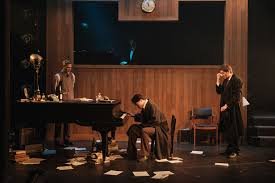
However, let’s move on. Directed by Frédéric Bélanger, the production, co-produced by Encore, feels distinctly out of time. Some will call it classic; others, dusty. While the designs are meticulous – Francis Farley-Lemieux (set design), Leticia Hamaoui (lighting), and Sylvain Genois (costumes) – they don’t aim to reinvent the wheel. Those who embrace the play’s realism and conventionality will find it well-executed.
Photo: Danny Taillon
The characters are colourful, bordering on caricature, but brought to life by skilled performers. Henri Chassé embodies the father, loving yet inadequate. Danielle Proulx is the possessive mother, very possessive. Catherine Renaud portrays the benevolent cousin, whose love is unrequited. Étienne Pilon is the loyal agent, a master of compromise. François-Simon Poirier delivers several smaller roles with flair. In the title role, Maxime de Cotret delivers a strong performance, opting for subtlety where others might have sensationalized the character – a man who today might be considered on the autism spectrum – into a spectacle.
It’s impossible to encapsulate a lifetime in 90 minutes, but the author seems to have focused on what could be called Gould’s eccentricities. Likely neuroatypical and certainly hypochondriacal, the musician had a close, almost symbiotic relationship with his mother. This is the core of the play, which also makes questionable choices regarding the music.
Photo: Danny Taillon
While Maxime de Cotret pretends to play the piano, a pianist performs live in the background. While acknowledging Gaël Lane Lépine’s talent and appreciating the presence of a live piano, the convention feels unconvincing. Was it impossible to find an actor who could play the piano? Another jarring moment occurs when Gould first records the Goldberg Variations, and we hear Simon Leoza’s electro-jazz composition instead of Bach’s masterpiece. It’s perplexing.
Gould famously stated: “The purpose of art is not the triggering of a momentary adrenaline rush, but the construction, over a lifetime, of a state of wonder and serenity.” Therefore, the greatest gift this play could offer is to spark curiosity about Gould’s ideas and interpretations. If it doesn’t fully honour his immense legacy, it might at least encourage audiences to discover his talent and uniqueness – a true gift from above.
Text: Ivan Calbérac.
Adaptation: Emmanuel Reichenbach.
Direction: Frédéric Bélanger.
A co-production of 9207-7569 Québec inc. and Encore. At Rideau Vert until April 18th. A tour will follow.