Breaking the Wall: The Engineering Marvel of Christopher Nolan’s The Odyssey
When it comes to cinematic ambition, Christopher Nolan is in a league of his own. His latest project, The Odyssey, is already being hailed as a milestone in film history, not just for its narrative, but for its uncompromising commitment to the 15/65 IMAX film format. While most directors treat IMAX as a tool for sweeping vistas, Nolan has turned it into the primary visual language of the entire production.
However, capturing the world of The Odyssey required more than just a great eye—it required some ingenious, practical engineering to solve a very human problem.
The IMAX Dilemma: When the Camera Becomes a Wall
The IMAX experience is legendary for its clarity and scale, but the hardware is notoriously demanding. As cinematographer Hoyte van Hoytema puts it, “IMAX is a camera that doesn’t lie.” This honesty comes with a price: the cameras are massive, mechanical, and incredibly loud.
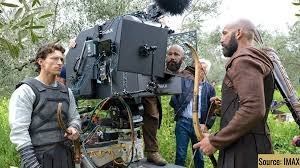
To capture clean dialogue, the crew used a “blimp”—a heavy sound-dampening housing. While the blimp solved the audio issue, it created a physical one. The resulting setup was so enormous that it essentially became a wall between the performers. In intimate dialogue scenes, actors found themselves physically blocked from seeing their co-stars, shattering the emotional connection and timing essential for a high-stakes performance.
The Mirror Solution: Restoring the Human Connection
In a fascinating revelation from the latest IMAX behind-the-scenes featurette, the production team implemented a custom mirror system. Instead of moving the camera—which would have compromised the shot—they adapted the environment to the technology.
- n
- The Purpose: To allow actors to maintain eyelines and read facial expressions despite the massive blimp in their way.
- The Result: A seamless blend of technical precision and emotional authenticity.
- The Philosophy: Adapting human geometry to fit the requirements of the 15/65 format.
A Tradition of Technical Bravery
This isn’t the first time Hoyte van Hoytema has pushed the boundaries of optical physics. Much like in the movie Nope, where a unique day-for-night rig was built using the ALEXA 65 Infrared system, the mirror system in The Odyssey is a prime example of “practical response” engineering. It isn’t technology for the sake of novelty; it is technology in service of the story.
Embracing Discomfort for Artistic Excellence
The production of The Odyssey serves as a masterclass in the “uncomfortable” side of filmmaking. From rugged locations and heavy gear to digital monitoring of analog capture, the team embraced every hardship to deliver a superior audience experience.
“We as filmmakers, we’re not supposed to be comfortable. We’re supposed to present the audience with the best experience possible.”
— Hoyte van Hoytema
The mirror system may seem like a small detail, but it represents the heart of the project: a relentless pursuit of perfection where no obstacle—not even a giant camera—is allowed to stand in the way of a genuine emotional moment.