Scornomics: How the ‘Terrible’ Movie Niulai Turned Online Ridicule into a Box Office Hit
In the world of cinema, there is a thin line between a disaster and a cult classic. Recently, a Chinese animated film titled Niulai (牛来) has crossed that line in the most unexpected way possible. It didn’t win awards for its art or storytelling; instead, it won the internet’s attention by being spectacularly bad.
The Humble (and Chaotic) Beginnings of Niulai
When Niulai first premiered on August 5th, it was virtually invisible. After ten days in theaters, its total box office stood at a meager 7,705 yuan—not millions, just a few thousand. The production was the definition of a “skeleton crew”: the director, lead actor, screenwriter, voice actor, and producer were all played by just two people. To add to the absurdity, reports suggest the production company was originally a home renovation business.
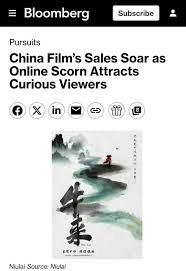
With crude animation and an awkward plot, the film seemed destined for immediate oblivion. However, the narrative shifted when Bloomberg stepped in with a report that captured the essence of the situation: “Sales soar as online scorn attracts curious viewers.”
The Rise of ‘Scornomics’
Why would people pay to watch something they already know is poor quality? The answer lies in a psychological cocktail of curiosity and the desire to participate in a collective joke. The film became so “bad” that it reached a new level of fascination.
Social media platforms like Douyin were flooded with clips featuring jarring visuals and cringeworthy sound effects—most notably a long, low, echoing moo that seems to haunt the viewers’ minds. This triggered a wave of “hate-watching,” where audiences flocked to cinemas just to see if the movie was truly as terrible as the internet claimed.
More Than Just a Meme: The Deconstruction of Failure
As the movie entered the mainstream consciousness, the internet began to project deeper meanings onto its flaws. What started as ridicule evolved into various interpretations:
- n
- The Underdog Dream: Some saw the crude effort as a raw, clumsy attempt by ordinary people to chase a dream.
- A Modern Fable: Others interpreted it as a metaphor for the struggle of the working class (the “oxen and horses” of society) and stock market investors.
- Human Touch vs. AI: In an era dominated by polished AI-generated content, some praised the “hand-made” (albeit rough) nature of the animation as a form of rebellion.
The Power of the Attention Economy
The turnaround of Niulai is a textbook example of the Attention Economy. In the digital age, negative attention is still attention. When a work is mocked on a massive scale, it ceases to be just a movie and transforms into a meme.
This phenomenon has birthed a concept we might call “Scornomics”—the process of converting negative reviews and online scorn into tangible commercial purchasing power. By becoming a “must-see” disaster, Niulai proved that in the current social media landscape, being “black-red” (notorious) is often more profitable than being ignored.
Have you ever watched a movie that was so bad it became great? Let us know in the comments—or better yet, give us a “moo”!