Hokum: When Personal Demons Meet Supernatural Nightmares
There is something eternally haunting about the trope of the tortured writer. From Poe to Stephen King, the image of a scribe battling inner demons is a cinematic staple. However, in Hokum, director Damian McCarthy takes this concept and twists it into a claustrophobic descent into madness and mystery.
A Bleak Beginning
The film opens not with a greeting, but with a shock. We are introduced to a brutal piece of fiction: a conquistador in a barren wasteland, a child in tow, and a glass bottle containing a map. In a moment of visceral cruelty, the man shatters the glass against the boy’s skull. It is bleak, unsettling, and serves as a window into the psyche of the man behind the keyboard: Ohm Bauman.
Played by Adam Scott, Bauman is a successful novelist whose fame hasn’t cured his existential dread. Surrounded by the ashes of his parents and a revolver that seems to call his name, Ohm is a man on the edge, searching for a closure that may not exist.
The Emerald Isle and the Billberry Woods
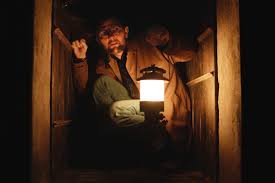
In a desperate bid for peace, Ohm travels to the Irish countryside, carrying his parents’ urns to the Billberry Woods Hotel—the very place where his parents honeymooned decades ago. The setting is a masterclass in atmosphere: part old-world hunting lodge, part quaint traveler’s inn, and entirely eerie.
While the hotel owner regales guests with tales of a local witch, Ohm finds a brief connection with Fiona, the enigmatic woman tending the bar. But in a story like Hokum, peace is merely a prelude to tragedy. Following a mysterious accident and a month-long hospital stay, Ohm returns to find a hotel closing for the season and Fiona missing.
Atmosphere Over Jump Scares
If you’ve seen McCarthy’s previous work, such as Oddity (2024), you know he has a knack for shadows. However, Hokum feels like a more refined evolution. Drawing comparisons to The Shining, the film balances slow-simmering dread with sharp, sudden shocks.
Why Adam Scott is the Perfect Lead
- n
- Range: Moving away from his comedic roots, Scott proves his depth in dramatic, dark roles (much like his acclaimed performance in Severance).
- Complexity: He portrays Ohm not as a sympathetic hero, but as a misanthrope—someone who is difficult to like, but impossible to stop watching.
- Intensity: His ability to lean into the “user-unfriendly” aspects of his character adds a layer of realism to the psychological horror.
The Meaning of ‘Hokum’
The title refers to Ohm’s initial cynicism toward Irish folklore. To him, the local legends of spirits and curses were mere hokum—nonsense and superstition. Yet, as the narrative unfolds, the line between psychological projection and supernatural reality begins to blur.
The film leaves us with a chilling reminder: while ghosts and ancient curses are terrifying, they often pale in comparison to the human monsters we carry within us. In the end, your personal demons might be the very thing that consumes you.
Looking for more psychological thrills? Keep an eye on Damian McCarthy’s filmography for more explorations of the uncanny and the unexplained.