Price of Gold Today and Beyond: World Bank Forecasts for 2026-2028
Understanding the Price of Gold Today: What the World Bank Forecasts for the Future
For investors and enthusiasts alike, keeping a close eye on the price of gold today is more than just a habit—it is a strategic necessity. In a world defined by geopolitical instability and shifting economic tides, precious metals remain the ultimate safe haven. However, a recent report from the World Bank suggests that while the outlook remains positive, the era of explosive, vertical gains may be transitioning into a phase of correction.
Gold Price Predictions: The Road to 2028
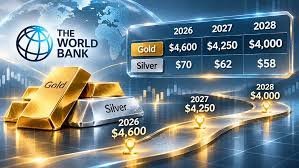
According to the World Bank’s October Commodity Markets Outlook, gold is poised to maintain historically elevated levels through 2027. However, the trajectory suggests a peak followed by a gradual decline. Here is the breakdown of the expected averages:
- n
- 2026: Gold is forecasted to average $4,600 per ounce, marking a significant 33.6% increase from 2025 levels.
- 2027: A slight correction is expected, with prices dipping about 7.6% to an average of $4,250 per ounce.
- 2028: The trend of moderation continues, with a further 5.9% decline, bringing the average to $4,000 per ounce.
While these numbers represent a decline from the 2026 peak, they remain remarkably high—more than three times the average levels seen between 2015 and 2019. This indicates that the underlying value of gold has fundamentally shifted upward.
Silver: High Volatility and Industrial Challenges
Silver is expected to follow a similar, albeit more volatile, path. While it significantly outperformed gold in the short term, it faces unique pressures due to its dual role as both a precious metal and an industrial commodity.
The World Bank predicts silver will hit an average of $70 per ounce in 2026 (a massive 76% annual gain), before sliding to $62 in 2027 and $58 in 2028. A key factor in this decline is the solar energy sector, where manufacturers are increasingly replacing silver with more cost-effective copper-based alternatives to reduce expenses.
What is Driving the Market? Bullish vs. Bearish Factors
To understand the fluctuations in the price of gold today, we must look at the tug-of-war between global economic forces:
🚀 The Bullish Drivers (Price Support)
- n
- Central Bank Demand: Central banks continue to diversify their reserves, providing a solid floor for prices.
- Geopolitical Tensions: Ongoing conflicts, particularly in the Middle East, keep the “safe-haven” demand high.
- Portfolio Diversification: Investors are increasingly using gold to hedge against systemic financial risks.
📉 The Bearish Pressures (Price Headwinds)
- n
- Monetary Policy: Tightening policies and interest rate hikes by the Federal Reserve make non-yielding assets like gold less attractive.
- Strong US Dollar: A dominant dollar typically puts downward pressure on commodity prices.
- Jewelry Demand: Sky-high prices have discouraged retail buyers, leading to a sharp decline in jewelry consumption since 2023.
Final Verdict for Investors
While the World Bank warns that the “explosive” volatility of 2026 may not repeat, the long-term fundamentals for precious metals remain healthy. The biggest risk remains the U.S. monetary policy; if interest rates stay higher for longer, gold may face further corrections. Conversely, any escalation in global conflict could send prices soaring well beyond current baseline forecasts.
Whether you are tracking the price of gold today for a short-term trade or a long-term hedge, the key is balance. Diversification remains the best strategy in an unpredictable global economy.
📰 You May Also Like