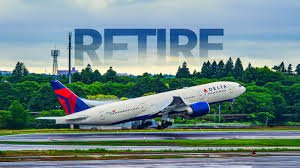
The Million-Dollar Gamble: Why Delta Airlines Walked Away from the Boeing 777
In the aviation world, retiring a fleet is usually a slow, calculated dance of aging airframes and rising maintenance costs. However, Delta Airlines stunned the industry in 2020 by abruptly removing its entire Boeing 777 fleet from service. What makes this move truly shocking? Just two years prior, the airline had invested a staggering $100 million in cabin retrofits to modernize these very aircraft.
While the decision coincided with the global turmoil of the COVID-19 pandemic, the story isn’t just about a drop in passenger numbers. It is a masterclass in aviation economics and the ruthless pursuit of operational efficiency.
The Breaking Point: COVID-19 and Financial Pressure
By the spring of 2020, the travel industry had hit a wall. International borders closed, and demand evaporated overnight. For Delta Airlines, the financial bleed was severe, with reports suggesting the carrier was burning approximately $50 million in cash every day during the peak of the crisis.
Faced with this reality, management stopped looking at fleet prestige and started looking at the bottom line. They asked one critical question: Which aircraft will actually make us money in the future?
Efficiency Over Sentiment: The A350 Advantage
The catalyst for the Boeing 777’s exit was the arrival of the Airbus A350-900. Delta Airlines was remarkably transparent about the math behind their decision. The data showed that the A350-900 burns roughly 21% less fuel per seat than the Boeing 777.
In an industry where fuel is one of the largest recurring expenses, a 21% improvement is not just a marginal gain—it is a competitive superpower. This efficiency allowed Delta to:
- n
- Boost Profitability: Lower fuel costs directly translate to higher margins on long-haul routes.
- Reduce Emissions: Aligning with global sustainability targets and reducing the environmental footprint.
- Simplify Operations: Moving toward a more streamlined fleet reduces training and maintenance complexity.
Ignoring the “Sunk Cost Fallacy”
Many critics questioned why Delta would scrap planes that had just received $100 million in upgrades, including the luxurious Delta One Suites. From a psychological standpoint, it seems wasteful. However, from a business perspective, that money was a sunk cost.
Continuing to fly less efficient aircraft just to “justify” a previous investment would have cost the airline far more in fuel and operating expenses over the next decade. Delta chose future performance over past spending—a ruthless but effective leadership move.
Overcoming Operational Hurdles
The transition wasn’t without challenges. The Boeing 777-200LR was a beast of range, enabling nonstop flights from Atlanta (ATL) to Johannesburg (JNB). Replacing such a specialized tool required a complete rethink of network scheduling.
Despite these hurdles, Delta concluded that occasional routing adjustments were a small price to pay for the massive efficiency gains provided by the Airbus fleet. The result? The Boeing 777s never returned to the skies for Delta.
Looking Ahead: A Future Defined by Airbus
The long-term validity of this strategy became clear in January 2026, when Delta placed an order for 31 additional Airbus widebodies (15 A350-900s and 16 A330-900s). This commitment signals that the Boeing 777 retirement wasn’t a temporary panic move, but a permanent shift in philosophy.
By prioritizing the most fuel-efficient technology available, Delta Airlines has positioned itself to navigate the volatile economics of international travel with a leaner, greener, and more profitable fleet.