
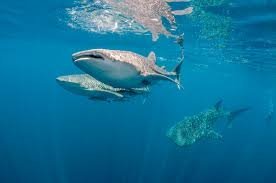
The Gentle Giant of the Deep: Unveiling the Secrets of the Whale Shark
In the warm, turquoise waters of Indonesia, a massive shadow glides just beneath the surface. With a mouth wide open and a presence that commands respect, this creature stretches over 18 meters in length. While its size might seem intimidating, there is absolutely nothing to fear. Meet the Whale Shark, the largest fish inhabiting our planet.
Larger than a school bus and heavier than twenty cars—often exceeding 20 tons—this titan of the sea swims with a slow, rhythmic grace. Despite its imposing stature, it is known as one of the most peaceful animals in the ocean.
Shark or Whale? Clearing the Confusion
Don’t let the name fool you. Despite being called a “Whale Shark,” this animal is not a whale; it is a true shark. The name is a nod to its immense size and its feeding habits, which closely resemble those of the great baleen whales.
The Whale Shark is a filter feeder. Its cavernous mouth can open up to 1.5 meters wide, but instead of sharp teeth designed for hunting, it uses a sophisticated filtration system to consume:
- n
- Plankton: Tiny organisms that drift with the currents.
- Fish Eggs: Millions of microscopic eggs floating near the surface.
- Small Crustaceans: Tiny shrimp-like creatures.
When a cloud of plankton appears, the shark glides slowly through the water, “vacuuming” everything in its path. Sometimes, its back and fins break the surface as it navigates these nutrient-rich zones.
Unexpected Friendships: The Art of Commensalism
The Whale Shark rarely travels alone. Often, it is accompanied by the Golden Trevally (Gnathanodon speciosus), a small golden fish that swims closely around the giant’s head. This is a classic example of commensalism.
The Golden Trevally gains several advantages from this partnership:
- Protection: Being near a 20-ton giant deters most predators.
- Efficiency: It “hitches a ride,” saving energy by swimming in the current created by the shark’s massive body.
- Food: It feeds on the scraps left behind during the shark’s meal.
The Magic of Cenderawasih Bay
In Indonesia’s Cenderawasih Bay, a unique interaction occurs. Whale sharks often gather around bagans—floating wooden platforms used by local fishermen. These platforms accidentally trap small baitfish, attracting the giants.
To prevent the sharks from damaging their nets, fishermen often toss small fish to them. This results in a breathtaking sight: these massive creatures tilting almost vertically to feed, leaving observers in complete awe of nature’s scale.
From the Ocean Floor to the Stars: Tracking the “Star-Covered Giant”
The scientific name for the Whale Shark is Rhincodon typus, which roughly translates to “giant covered in stars.” This is a poetic description of its dark skin, which is dotted with a unique pattern of white spots.
These spots are as unique as human fingerprints. In a brilliant crossover between marine biology and astronomy, scientists are using software originally designed for the Hubble Space Telescope. The same technology used to measure the distance between galaxies is now used to map the spots on a Whale Shark’s skin.
By “reading” these cosmic patterns, researchers can identify individual sharks and track their migrations across the globe for years, providing invaluable data for ocean conservation efforts.
Conclusion: From the depths of Indonesian bays to the algorithms of space exploration, the Whale Shark reminds us that nature is full of surprises. Protecting these gentle giants is not just about saving a species, but about preserving the wonder of our world’s news and natural history.



