
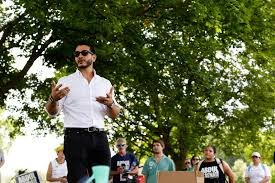
Abdul El-Sayed: The Progressive Firebrand Challenging the Democratic Establishment in Michigan
The political landscape in Michigan is currently the epicenter of a philosophical war within the Democratic Party. At the heart of this storm is Abdul El-Sayed, a former public health official and progressive champion who is attempting to prove that the traditional definition of “electability” is obsolete.
As the August 4 Democratic Senate primary approaches, the race has evolved into a high-stakes showdown. It is no longer just about a seat in Washington; it is a referendum on the future of the party: do they lean into a moderate, safe center, or do they embrace a bold, progressive insurgency?
A Clash of Visions: El-Sayed vs. Stevens
The primary has narrowed down to a head-to-head battle between two starkly different political identities:
- n
- Abdul El-Sayed: Backed by heavyweights like Bernie Sanders and Alexandria Ocasio-Cortez, El-Sayed represents the progressive wing. His platform focuses on Medicare for All, systemic healthcare reform, and a fearless critique of corporate influence in politics.
- Haley Stevens: A moderate Representative with a proven track record of winning in “red turf.” She is the preferred candidate of the party establishment, boasting endorsements from Nancy Pelosi and other senior Democratic leaders.
Beyond the Ideological Spectrum
While pundits frame the race as “Center vs. Left,” Abdul El-Sayed argues that this lens misses the actual cravings of the electorate. In recent interviews, El-Sayed has emphasized that the average voter isn’t preoccupied with ideological labels, but with survival.
“I don’t think most voters walk around thinking where they stand on the ideological spectrum,” El-Sayed noted. “I think most voters are just being like, ‘Damn, I can’t afford my health care. I’m worried about losing my job. This AI stuff feels scary.’”
For El-Sayed, the path to victory isn’t about moving to the center; it’s about being honest, direct, and fearless in fighting for the working class.
The “Electability” Trap and the Blue Wall
The Democratic establishment is haunted by the fear that El-Sayed is “too radical” for Michigan, a critical state in the so-called “Blue Wall.” Critics point to his stances on cutting aid to Israel and his previous rhetoric on policing as potential liabilities in a general election against Republican Mike Rogers.
However, El-Sayed challenges this narrative by pointing to Michigan’s volatile voting history. He argues that voters in the Midwest are not fickle, but are simply searching for a candidate who offers genuine relief from economic pain rather than polished political platitudes.
High Stakes for the 2026 Midterms
The outcome of this primary could ripple across the entire U.S. Senate. With the party needing a net gain of four seats to secure a majority, Michigan is a non-negotiable win.
While Haley Stevens positions herself as the “workhorse” capable of delivering results, El-Sayed is positioning himself as the disruptor. From dancing on social media to challenging the influence of AIPAC, El-Sayed is betting that voter enthusiasm and authenticity will outweigh traditional campaign strategies.
Conclusion: A New Blueprint for Politics?
Whether Abdul El-Sayed wins or loses, his campaign highlights a growing frustration within the Democratic base. Voters are increasingly tired of “strongly worded letters” and are demanding bold action on healthcare, housing, and economic inequality. In Michigan, the battle is about more than one seat—it’s about whether the Democratic Party can evolve to meet the urgency of the moment.



