
Earthquake Now: Why Hawaii Experiences Powerful Deep Shakes
For residents and visitors in the Hawaiian Islands, the feeling of the ground shifting can be alarming. While many associate seismic activity exclusively with volcanic eruptions, the reality of earthquake now trends in Hawaii is more complex. Recent events, including a significant magnitude-6.0 earthquake on May 22, have reminded us that the islands are subject to powerful forces acting deep beneath the ocean floor.
Recent Seismic Activity: What Happened?
In the window of May and June 2026, the Island of Hawaii experienced a series of notable seismic events. The most prominent was the M6.0 earthquake that struck beneath the west side of the island, southeast of Captain Cook, at a depth of 14 miles (23 km).
Following this, two other distinct events were felt statewide:
- June 2: A magnitude-4.6 earthquake northwest of Keauhou (21 miles deep).
- June 9: A magnitude-4.7 earthquake east of Pepe’ekeo (24 miles deep).
Interestingly, while these events felt similar, they were unrelated to one another and, more importantly, unrelated to volcanic magma movement.
The Science of ‘Flexure Events’: The Bowling Ball Effect
If these aren’t caused by volcanoes, why do they happen? To understand this, we have to look at Hawaii’s unique geography. Unlike California or Japan, Hawaii is not located on a tectonic plate boundary (the “Ring of Fire”). Instead, it sits in the middle of the Pacific plate, created by a mantle plume or “hot spot.”
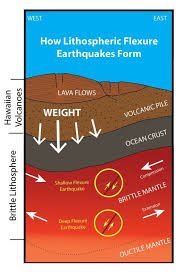
As the Pacific plate moves, the massive weight of shield volcanoes like Maunakea and Mauna Loa literally bends the Earth’s crust. Geologists describe this using a simple analogy: imagine a bowling ball sitting on a bed. The ball sinks into the mattress, creating folds in the blankets that radiate outward.
In this scenario, the “blankets” are the brittle oceanic crust. When the crust bends too far under the immense weight of the islands, the strain is released as a flexure earthquake. Because these occur deeper in the dense lithosphere, the seismic waves travel further without losing energy, making them felt across a much larger area than typical shallow volcanic quakes.
Volcanic Activity vs. Flexure Earthquakes
It is crucial to distinguish between different types of seismic activity. While flexure events are caused by weight and bending, other quakes are caused by the movement of magma. For instance, the Pahala seismic swarm produces deep earthquakes related to magma transport pathways, rather than crustal bending.
Current Volcano Status Update
According to the USGS Hawaiian Volcano Observatory (HVO), the current status of the major volcanoes is as follows:
- Kilauea: Currently under an ADVISORY level. Episodic lava fountaining continues within the summit caldera, with new episodes predicted periodically.
- Mauna Loa: Currently at a NORMAL alert level and is not erupting.
How to Stay Safe During an Earthquake
Whether it is a deep flexure event or a volcanic tremor, the safety protocols remain the same. If you feel the ground shake, remember the golden rule: “Drop, Cover, and Hold-on.”
Additionally, if you are near the coast and feel strong shaking, move inland or to higher ground immediately in case a tsunami is generated. For the most accurate and real-time data on earthquake now activity, always refer to official USGS updates.



