
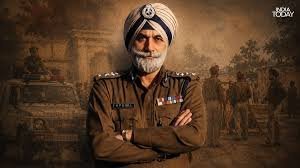
The Man Behind the Myth: Who Was KPS Gill?
Few figures in the history of Indian policing are as divisive as KPS Gill. To some, he was the “Supercop”—the iron-fisted leader who restored order to a state ravaged by violence. To others, he represents a dark era of state-sponsored excesses and human rights violations. Recently, the debate surrounding his legacy has resurfaced, sparked by the controversial film Satluj (originally titled Panjab ’95), starring Diljit Dosanjh.
The film delves into the harrowing story of human rights activist Jaswant Singh Khalra, whose disappearance in 1995 remains a focal point of the allegations against Gill. While Gill was never convicted of Khalra’s murder, his name remains inextricably linked to the shadows of the 1990s.
Early Career and the Assam Controversies
Long before he became a household name in Punjab, KPS Gill’s career began in the Assam-Meghalaya cadre. His time in Assam was a precursor to the aggressive tactics he would later employ. During the height of the Assam Agitation (1979-1985), Gill served as the Deputy Inspector General of Police (DIG).
His reputation was first marred by the death of Khargeshwar Talukdar, a young leader of the All Assam Students’ Union (AASU). Talukdar died following a brutal lathi-charge ordered by Gill to stop protesters. This incident established Gill’s image as a “tough” officer who prioritized results over diplomacy.
The Battle for Punjab: Operation Black Thunder II
KPS Gill’s defining chapter unfolded in his home state of Punjab. Drafted to combat the Khalistani insurgency, he ascended to the position of Director General of Police (DGP) in 1988. His most celebrated military achievement was Operation Black Thunder II.
Unlike the previous Operation Blue Star, which left the Golden Temple heavily damaged, Gill’s approach to Black Thunder II focused on:
- n
- Precision Operations: Targeted strikes to minimize collateral damage.
- Strategic Siege: Cutting off supplies to militants within the temple complex.
- Negotiations: Using a combination of pressure and dialogue to force a surrender.
By the mid-1990s, the insurgency had largely collapsed. His supporters credit his intelligence-led operations and relentless pressure as the primary reasons for the return of normalcy in the region.
The Dark Side of the ‘Supercop’ Legacy
The restoration of peace came at a significant cost. Human rights organizations and eyewitnesses have long accused the Punjab Police under Gill’s leadership of committing grave atrocities, including:
- n
- Enforced Disappearances: Thousands of individuals allegedly “vanished” during counter-insurgency sweeps.
- Custodial Killings: Reports of “fake encounters” used to inflate success rates.
- The Khalra Case: The abduction and murder of Jaswant Singh Khalra, who exposed secret cremations conducted by the police.
Despite these accusations, Gill consistently maintained that “extraordinary circumstances required extraordinary measures,” defending the force’s actions as necessary for national security.
A Fall from Grace and Final Years
Gill’s retirement in 1995 did not bring peace. His public image suffered a severe blow in 1996 when he was found guilty of sexually harassing senior IAS officer Rupan Deol Bajaj. This conviction stripped away much of the prestige associated with his police record.
Furthermore, in 2012, activists in the UK successfully campaigned to bar him from attending the London Olympics, citing his alleged role in human rights abuses. KPS Gill passed away in 2017, but he leaves behind a legacy that remains a battleground of narratives.
Conclusion: Hero or Villain?
KPS Gill remains a symbol of the complex tension between state security and individual liberty. Whether he is viewed as the savior of Punjab or a perpetrator of state violence, his impact on the geopolitical landscape of India is undeniable. As films like Satluj bring these stories back to the mainstream, the world is forced to ask: At what price does peace come?



