
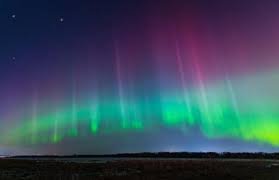
Chasing the Lights: Aurora Borealis Expected to Illuminate North American Skies
Get your cameras ready and head away from the city lights! A rare celestial event is unfolding as the Aurora Borealis—the mesmerizing Northern Lights—is expected to be visible across a vast portion of North America from July 3rd to July 4th.
While summer sightings are less common due to the long daylight hours, a series of powerful solar events is creating the perfect storm for stargazers to witness this natural wonder.
What is Triggering the Aurora Borealis?
The current activity is driven by multiple Coronal Mass Ejections (CMEs). These are massive clouds of magnetic fields and charged particles streaming from the sun at staggering speeds—up to 3,000 kilometres per second.
When these particles collide with Earth’s magnetic field, they trigger geomagnetic storms. Experts are predicting storms ranging from G1 to G3 class. According to SpaceWeather.com, a series of direct and glancing blows from these CMEs could spark significant displays over the holiday weekend.
Where Can You See the Northern Lights?
Visibility depends heavily on the intensity of the geomagnetic storm. Here is a breakdown of where you might spot the glow:
- n
- G1 to G2 Storms: Likely visible in northern border states and provinces, including Montana, North Dakota, Minnesota, and northern Wisconsin.
- G3 Storms (Strong): If a G3-class storm materializes, the aurora could push much further south, potentially reaching Kansas, Missouri, Kentucky, West Virginia, Virginia, and Maryland.
Challenges for Summer Viewing
Seeing the Aurora Borealis in July isn’t as simple as in winter. Two main factors could hinder your view:
- The Strawberry Moon: The waning moon in the southern sky may create light pollution that washes out fainter auroral displays.
- Daylight Hours: Following the summer solstice, the nights are shorter and not fully dark, meaning you’ll need to find the narrowest window of darkness to see the colours.
Pro Tips for Spotting and Photographing the Aurora
To maximize your chances of a successful sighting, follow these expert recommendations:
- Timing: Look toward the northern horizon around midnight.
- Location: Get as far away from urban light pollution as possible. Dark-sky preserves are your best bet.
- Photography: The human eye often struggles to see colour in faint auroras. Use a tripod and long-exposure settings on your smartphone or DSLR to capture the vivid greens and purples.
How to Track the Aurora in Real-Time
Don’t leave it to chance. You can monitor solar wind and magnetic field data using high-authority tools. The Bz component of the interplanetary magnetic field is the key; when it swings south (a sustained southward Bz of −5 nT or stronger), the aurora is likely to appear.
Recommended Resources:
- NOAA Space Weather Prediction Center (For 30-minute forecasts).
- Mobile Apps: Download Aurora Now, My Aurora Forecast, or Glendale Aurora for instant alerts.
Planning a Future Adventure?
While these July sightings are exciting, they are often just a faint glow on the horizon. For those seeking a truly life-changing experience—where the lights dance across the entire sky—the best time to visit auroral latitudes (65 to 70 degrees north) is between September and March.
Consider planning a trip to Northern Canada, Alaska, or Scandinavia (Norway, Finland, Sweden, and Iceland) to witness the Aurora Borealis in its full, dramatic glory.
Wishing you clear skies and wide eyes!



