
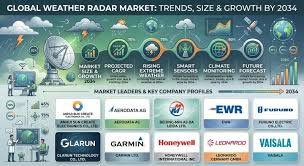
Weather Radar Technology: Revolutionizing Precision Forecasting and Safety
In an era where climate volatility is becoming the new norm, the ability to predict atmospheric changes with precision is not just a convenience—it is a necessity. From the vast prairies of Saskatchewan to the rugged coasts of Nova Scotia, weather radar technology plays a pivotal role in safeguarding lives and optimizing industries across Canada.
But what is driving the current evolution of the weather radar market, and how is this technology evolving to meet the challenges of the 21st century?
What Exactly is Weather Radar?
At its core, weather radar (Radio Detection and Ranging) works by emitting electromagnetic pulses that bounce off precipitation, such as rain, snow, or hail. By measuring the time it takes for the signal to return and the shift in its frequency, meteorologists can determine the intensity, movement, and altitude of weather systems.
The most significant breakthrough in recent decades has been the Doppler Radar. Unlike conventional radar, Doppler technology can detect the motion of particles, allowing experts to identify rotation within storms—a critical factor in issuing early warnings for tornadoes and severe windstorms.
Key Drivers of the Weather Radar Market
The global demand for advanced radar systems is surging due to several critical factors:
- n
- Climate Change: An increase in extreme weather events has forced governments to invest in higher-resolution monitoring systems.
- Urbanization: Growing cities require more precise “nowcasting” to manage traffic and public safety during flash floods or snowstorms.
- Technological Integration: The shift toward dual-polarization radar allows for better differentiation between rain, snow, and non-meteorological echoes (like birds or insects).
How Weather Radar Impacts Critical Industries
Precision forecasting isn’t just for news reports; it is a cornerstone of the modern economy. Several sectors rely heavily on real-time radar data:
1. Aviation and Aerospace
Pilots use onboard weather radar to avoid turbulence and severe thunderstorms, ensuring passenger safety and fuel efficiency. For more information on aviation safety standards, you can visit the International Civil Aviation Organization (ICAO).
2. Agriculture
Canadian farmers utilize precipitation data to optimize planting and harvesting schedules, reducing crop loss and improving yield through data-driven decision-making.
3. Emergency Management
Government agencies, such as Environment and Climate Change Canada, use radar networks to issue timely alerts, allowing citizens to seek shelter and emergency services to deploy resources effectively.
The Future: AI and Machine Learning in Meteorology
The next frontier for weather radar is the integration of Artificial Intelligence (AI). By feeding massive amounts of radar data into machine learning algorithms, meteorologists can now predict storm paths with unprecedented accuracy.
AI can identify patterns that the human eye might miss, reducing false alarms and providing more lead time for evacuations. This synergy between hardware (radar) and software (AI) is transforming the weather radar market into a high-tech data ecosystem.
Conclusion
As we continue to face unpredictable weather patterns, the importance of sophisticated weather radar systems cannot be overstated. From protecting infrastructure to saving lives, these technological marvels are our first line of defence against the elements.
Whether it is through government investment or private sector innovation, the advancement of radar technology ensures that we are no longer just reacting to the weather—we are anticipating it.



