Understanding the Recent X8.1 Solar Flare & Space Weather Implications
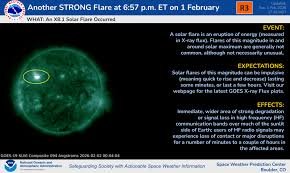
The Space Weather Prediction Center (SWPC), a branch of the National Oceanic and Atmospheric Administration (NOAA), has reported a significant event in our Sun’s activity: a powerful X8.1 solar flare originating from Region 4366 at 6:57 pm ET. This flare, categorized as an X-class flare – the most intense – has sparked interest and concern regarding potential impacts on Earth and our technological infrastructure.
What are Solar Flares?
Solar flares are sudden releases of energy from the Sun’s surface, often associated with sunspots. These eruptions emit radiation across the electromagnetic spectrum, from radio waves to X-rays and gamma rays. X-class flares are the strongest, capable of causing widespread radio blackouts and long-lasting radiation storms.
The X8.1 Flare: Details and Forecast
The recent X8.1 flare is particularly noteworthy. Modeling of the coronal mass ejection (CME) – a large expulsion of plasma and magnetic field from the Sun – associated with this flare suggests that the bulk of the material will pass by Earth to the north and east, arriving late on February 5th (UTC-day). While a direct hit is unlikely, there’s a possibility of glancing influences. This means we could experience minor geomagnetic disturbances.
Region 4366 remains highly active, continuing to produce both M-class and X-class flares as of early Monday morning. SWPC forecasters anticipate further exciting activity from this region in the coming days, urging continued monitoring of space weather conditions.
Potential Impacts on Earth
While the CME is expected to largely miss Earth, even glancing blows can have effects. These include:
- Radio Blackouts: X-class flares can disrupt high-frequency (HF) radio communications, impacting aviation, maritime operations, and emergency services.
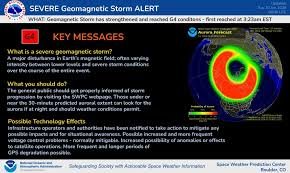
- Geomagnetic Storms: These storms can induce currents in power grids, potentially leading to blackouts. They can also affect satellite operations and GPS accuracy.
- Aurora Displays: Increased geomagnetic activity often results in spectacular aurora displays (Northern and Southern Lights) visible at lower latitudes than usual.
- Satellite Disruptions: Satellites are vulnerable to radiation damage and atmospheric drag during strong solar events.
Staying Informed
The SWPC provides real-time space weather alerts and forecasts. You can find the latest information on their website: https://www.swpc.noaa.gov/. Understanding space weather is crucial for protecting our technology and infrastructure in an increasingly interconnected world.
For more information on NOAA and its National Weather Service, visit https://www.noaa.gov/.
Disclaimer: This information is based on current forecasts and observations. Space weather is inherently unpredictable, and conditions can change rapidly.