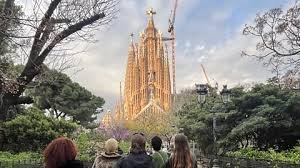
The Living Legacy of “God’s Architect”: Unveiling the Secrets of the Sagrada Família
In the heart of Barcelona, a structure rises that defies traditional architectural logic. The Sagrada Família is not merely a building; it is an organic behemoth, a “Bible in stone” that continues to evolve long after the passing of its creator, Antoni Gaudí. Known as “God’s architect,” Gaudí blended a deep spiritual devotion with a mathematical obsession, creating a landmark that now stands as the tallest church in the world.
A Vision Beyond His Time
Antoni Gaudí’s journey ended tragically in 1926 after a tram accident, but his vision was far from finished. He sought to correct the “errors” of previous architectural styles, viewing the flying buttresses of Neo-Gothic cathedrals as mere “crutches”—unnecessary supports for buildings that couldn’t sustain their own weight. To solve this, Gaudí looked back to ancient wonders, specifically the Arch of Taq-iKisra in present-day Iraq.
The Magic of the Catenary Arch
The secret to the Sagrada Família’s soaring height lies in the catenary arch. Imagine a chain hanging freely between two points; the curve it forms is a natural expression of gravity. By flipping this curve upside down, Gaudí created a structure of extreme stability. This allowed him to:
- n
- Eliminate the need for external supports (flying buttresses).
- Create internal columns that mimic the form of trees, branching out to support the massive weight of the roof.
- Design a space that feels weightless, bathed in the ethereal glow of stained-glass windows.
Bridging the Gap: Ancient Inspiration meets Modern Engineering
Completing Gaudí’s dream posed an almost impossible challenge, especially after many of his original sketches were destroyed during the Spanish Civil War. Modern structural engineers, including the world-renowned firm Arup, have stepped in to translate Gaudí’s organic forms into reality using 21st-century technology.
One of the greatest breakthroughs was the use of pre-stressed stone panels. Traditionally, masonry is strong under compression but weak under tension (which occurs when wind pushes against a tower). By inserting internal steel tendons into the stone, engineers added artificial compression, making the towers significantly stronger and more resistant to the elements without adding excessive weight.
The Pinnacle of Achievement: 172.5 Metres of Wonder
With the inauguration of the Tower of Jesus Christ, the Sagrada Família has reached a staggering height of 172.5m (566ft), officially claiming the title of the tallest church globally. This milestone coincides with the centenary of Gaudí’s death, proving that his ambition was matched only by the ingenuity of those who followed him.
The Future: AI and Drones in Conservation
The Sagrada Família is not a static monument; it responds to wind and temperature like a living organism. To ensure its longevity, the basilica has moved beyond manual inspections. Today, the team utilizes:
- High-resolution drones to survey the towering spires.
- Artificial Intelligence (AI) to detect micro-cracks and structural shifts in record time.
What once took human climbers two years to survey can now be accomplished in a single month thanks to AI, ensuring that the “Bible in stone” remains secure for generations to come.
For those planning a visit to this architectural marvel, the official Sagrada Família website provides the latest updates on the construction progress and visiting hours.