
A Lost World Revealed: The Rare Meteorite That Rewrites Solar System History
Imagine a world as massive as our Moon, roaming the early reaches of our solar system, only to be completely obliterated billions of years ago. For decades, this world remained a ghost, leaving no trace—until a small, one-pound rock was discovered in the sands of the Sahara Desert.
The meteorite, officially catalogued as Northwest Africa (NWA) 12774, is more than just a space rock; it is a cosmic time capsule. According to a groundbreaking study published in Earth and Planetary Science Letters, this rare specimen provides the first definitive evidence of a long-lost protoplanet that may have rivalled the Moon in size.
What Makes NWA 12774 So Special?
Scientists classify NWA 12774 as an angrite. Angrites are incredibly scarce—of the more than 80,000 meteorites recovered on Earth, only 68 are known angrites. These are some of the oldest volcanic rocks in existence, forming roughly 4.5 billion years ago, shortly after the birth of the sun.
What truly sets this meteorite apart is its chemical composition. Unlike Earth or Mars, angrites contain very little silica (the primary component of sand and planetary crusts). This unusual signature suggested to researchers that the materials forming this parent body followed a completely different evolutionary path than the rocky planets we know today.
The Smoking Gun: Extreme Pressure
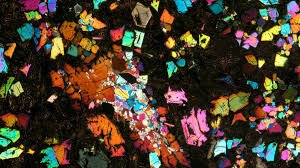
For a long time, scientists assumed angrites came from small asteroids. However, lead author Aaron Bell and his team at the University of Colorado Boulder discovered something startling inside NWA 12774: crystals of a mineral called clinopyroxene.
- n
- Aluminum Rich: These crystals were exceptionally rich in aluminum, a key indicator of formation under immense pressure.
- Crushing Force: The team calculated that the rock required pressures of at least 17.5 kilobars to form.
- Comparison: That is over 17 times the pressure found at the bottom of the Mariana Trench, the deepest point in our oceans.
Such extreme pressure is impossible inside a small asteroid. To generate this force near the surface (where the crystals’ sharp edges suggest they formed), the parent body had to be massive.
A Moon-Sized Mystery
Based on these findings, researchers estimate the lost world had a radius exceeding 1,800 kilometres. This puts it in the same size class as Earth’s Moon and potentially approaching the scale of Mars.
“It’s incredible to think there was once a world this large,” says Bell. “We only know it existed because a few fragments of it happened to land on Earth.”
What Happened to This Ancient World?
The fate of this protoplanet was likely violent. The early solar system was a chaotic place, defined by massive collisions that reshaped planetary orbits and destroyed entire worlds. It is believed that this lost world was shattered in one of these cataclysmic events, scattering fragments across space—some of which eventually collided with Earth.
This discovery, supported by data and research often highlighted by NASA, suggests that our understanding of the solar system’s early history is still incomplete. There are likely many more “lost worlds” hiding in plain sight, waiting in museum drawers and laboratory archives to be analyzed.
The story of NWA 12774 reminds us that even the smallest pebble from the desert can hold the secrets of a vanished empire of stone and fire from the dawn of time.



