
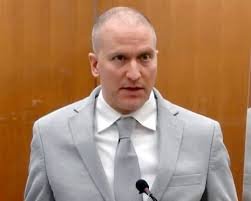
Outrage Erupts After Minnesota GOP Honors Derek Chauvin: A Gesture of ‘Profound Cruelty’?
A wave of indignation has swept across Minnesota following a highly controversial decision by the state’s Republican Party. During their annual convention in Duluth, party members held a moment of silence for Derek Chauvin, the former police officer convicted of the brutal murder of George Floyd. The gesture has sparked a fierce backlash, most notably from Minnesota Attorney General Keith Ellison, who led the prosecution in the landmark case.
An ‘Act of Profound Cruelty’
Attorney General Keith Ellison did not mince words in his reaction to the event. In a scathing statement, the Democrat described the tribute as an “act of profound cruelty” toward the family of George Floyd and a slap in the face to law enforcement officers who serve with honor.
Ellison emphasized that the timing of the gesture—occurring just days after the anniversary of Floyd’s death—only deepened the wound. According to Ellison, honoring a man who disgraced his oath and his badge is not only disturbing but also undermines the very principle of legal accountability.
“This decision dishonors the memory of George Floyd and wounds his loved ones all over again,” Ellison stated, highlighting the permanent and irreparable loss suffered by Floyd’s children, siblings, and community.
The Legal Reality of Derek Chauvin
To understand the gravity of the controversy, it is essential to recall the facts of the case. Derek Chauvin was sentenced to 22.5 years in prison in 2021 for the second-degree murder of George Floyd. The world watched in horror as footage showed Chauvin kneeling on Floyd’s neck for over nine minutes on May 25, 2020.
- n
- Civil Rights Violations: In 2022, Chauvin received an additional 21-year sentence for violating Floyd’s civil rights.
- Legal Appeals: Chauvin has exhausted nearly all legal avenues, with both state courts and the U.S. Supreme Court denying his appeals.
- Current Status: As of August 2024, Chauvin was moved to a low-security facility in Texas.
A New Political Narrative
While the legal system has rendered its verdict, Chauvin has unexpectedly become a cause célèbre for certain right-wing influencers and conservative figures. Personalities like Ben Shapiro have questioned the cause of Floyd’s death, while figures like Elon Musk have amplified calls for a potential presidential pardon from Donald Trump.
Political analysts suggest that while a federal pardon might not secure Chauvin’s immediate release—as he is serving a state sentence—it would signal a massive shift in the political discourse surrounding police brutality and racial injustice.
Community and Political Backlash
The reaction wasn’t limited to the Attorney General. Democratic state lawmaker Jamie Long took to X (formerly Twitter) to label the act as “disgusting,” questioning why the GOP chose to honor a convicted murderer rather than victims of gun violence or fallen soldiers.
The death of George Floyd served as a catalyst for the global Black Lives Matter movement, bringing systemic racism and police brutality to the forefront of international conversation. This latest incident in Minnesota suggests that the battle over the legacy of that tragedy is far from over.
As Minnesota continues to grapple with these tensions, the divide between the pursuit of justice and political symbolism has never been more apparent.



