
The Middle East on Edge: A New Wave of Military Confrontation
The geopolitical landscape of the Middle East has reached a volatile tipping point. Recent reports of iran strikes and immediate US retaliations have signaled a dangerous escalation in the ongoing conflict between Washington and Tehran. From the strategic shores of Bandar Abbas to the precarious waters of the Strait of Hormuz, the region is witnessing a high-stakes game of military brinkmanship.
Direct Clashes: Bandar Abbas and US Air Bases
The cycle of violence intensified early Thursday when the US military conducted precision strikes targeting Iranian drones and a ground control station in Bandar Abbas. According to US officials, the operation was a defensive measure to neutralize imminent threats to commercial traffic and military personnel.
In a swift response, Iran’s Islamic Revolutionary Guard Corps (IRGC) claimed to have launched a retaliatory attack against an American air base, which they identified as the source of the initial US aggression. While the IRGC did not specify the exact location of the base, the move was described as a “serious warning” that any further US actions would not go unanswered.
The Strategic Battle for the Strait of Hormuz
At the heart of this conflict lies the Strait of Hormuz, one of the world’s most critical oil chokepoints. The stakes are astronomical, as approximately one-fifth of the world’s daily oil production passes through this narrow waterway. According to the U.S. Energy Information Administration (EIA), any prolonged disruption here could trigger a global energy crisis.
- Iranian Control: Tehran has threatened to block “hostile countries” from traversing the strait.
- US Demands: President Donald Trump has insisted that the strait remains “open to everybody,” vowing that the US will oversee its security.
- Maritime Tension: Reports indicate that several vessels were forced to turn back after warning shots were fired by Iranian forces.
Trump’s “No-Rush” Diplomacy and Nuclear Red Lines
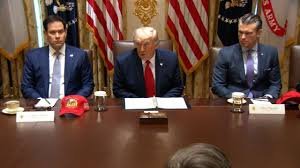
President Donald Trump has adopted an unusually aggressive diplomatic posture, explicitly stating that he will not be rushed into a deal. In a recent Cabinet meeting, Trump dismissed concerns regarding the political impact of the conflict, stating, “I don’t care about the midterms,” emphasizing that he is prepared to “finish the job” if a favorable agreement is not reached.
The administration’s red lines are clear: no sanctions relief and no financial concessions until Iran completely dismantles its stockpile of highly enriched uranium. Trump has further suggested that a peace deal might be contingent on other Middle Eastern nations joining the Abraham Accords to normalize ties with Israel.
Regional Spillover: Israel and Hezbollah in Lebanon
The conflict is not contained within US-Iran borders. The Israeli military has significantly intensified its operations in Southern Lebanon, targeting Hezbollah infrastructure. In a massive escalation, Israel issued one of its largest-ever evacuation warnings for the city of Tyre, reporting strikes against over 150 sites within a 24-hour window.
What Happens Next?
As the United Nations monitors the situation, the world watches to see if the current memorandum of understanding (MOU) being negotiated via Pakistani mediation will hold. With both sides refusing to blink, the risk of a full-scale regional war remains a haunting possibility.



