
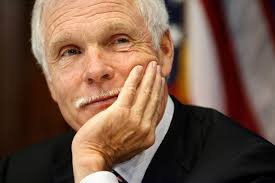
The Legacy of Ted Turner: The Man Who Thought Bigger Than Capitalism
Ted Turner didn’t just build companies; he built empires. From the birth of the 24-hour news cycle to his ventures into sustainable bison ranching, Turner operated on a scale that few in history have ever dared. Until his passing at 87, Turner remained the quintessential American maverick—a man whose appetite for risk was as legendary as his success.
An Evening at Montana Grill: A Glimpse into a Giant
To understand Ted Turner, one must understand his obsession with the “Big Sky.” In 2006, at the opening of Ted’s Montana Grill in Manhattan, Turner’s personality was on full display. The restaurant was a curated 18th-century saloon fantasy, serving bison as a sustainable, healthier alternative to beef. It was an oasis of sustainability tucked away in the concrete canyon of New York City.
Even in a room full of potential guests, Turner’s presence was singular. He wasn’t just a businessman; he was a promoter of ideas, whether it was the health benefits of bison or the necessity of eliminating plastic straws long before it became a global trend.
The Power Struggle: Ted Turner vs. Jerry Levin
While Turner is celebrated as the founder of CNN, his tenure within the Time Warner empire was marked by a Machiavellian struggle for control. After selling Turner Broadcasting to Time Warner in 1996 for roughly $7.5 billion in stock, Turner found himself in a golden cage.
The transition wasn’t seamless. Turner was bound by a “standstill agreement,” a corporate straight-jacket that prevented him from taking hostile actions or purchasing more stock. This effectively neutralized the voluble maverick, forcing him to support the regime of CEO Jerry Levin.
The Strategic “Neutering” of a Mogul
- n
- The Ambition: Turner refused to be a “Vice” anything; he wanted the helm of the world’s largest media conglomerate.
- The Maneuver: The AOL merger was not just a business move; it was a strategic strike.
- The Result: The blizzard of new shares issued during the AOL deal diluted Turner’s ownership from 11% to roughly 4%, stripping him of the power to replace Levin as CEO.
The Most Expensive Lesson in Capitalism
The merger between AOL and Time Warner is now studied in business schools as one of the most disastrous corporate unions in history. As the shares tanked, Turner’s frustration boiled over. By 2003, he dumped nearly all his Time Warner stock after the value had cratered by almost 80%.
“I lost more money than anyone in the history of capitalism!”
Turner’s stake, which was worth approximately $11 billion in 1999, dwindled to about $3 billion by the time he exited. Yet, in true Turner fashion, he wore this loss as a badge of honor. To him, losing on such a colossal scale was simply proof that he had played a game larger than anyone else.
Conclusion: A Life of Outrageous Ambition
Whether he was pursuing the America’s Cup or transforming the way the world consumes news, Ted Turner lived life without a middle gear. He taught us that while the risks of “Thinking Big” can lead to staggering losses, the reward is a legacy that reshapes entire industries.
For more insights into corporate strategy and the history of media mergers, explore the archives of Fortune Magazine.



