Mark Pope and the Kentucky Wildcats: A Recruiting Crisis at Rupp Arena
The moment was televised, tense, and ultimately heartbreaking for the Big Blue Nation. As Tyran Stokes, the top-ranked player in the 2026 recruiting class, prepared to reveal his college commitment on ESPN’s NBA Tip-Off, the atmosphere was electric. Charles Barkley noted the abundance of blue wrapping paper, hinting at a Kentucky commitment. But the reveal was a cold shower for Kentucky fans: Stokes pulled out a personalized NBA 2K cover featuring himself in a red Kansas jersey.
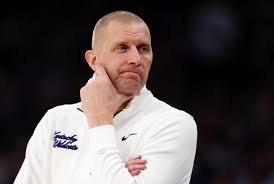
For Mark Pope, this wasn’t just one missed recruit; it was a symbolic blow to a program that has historically viewed five-star commitments as a birthright. As the honeymoon phase ends, Pope finds himself in the crosshairs of one of the most demanding fan bases in college sports.
The Recruiting Nightmare: A Pattern of Misses
The struggle isn’t limited to high school sensations. Kentucky’s performance in the transfer portal has been alarmingly mediocre. While the Wildcats once dominated the landscape, they currently sit with a No. 13 portal class, lacking the high-impact stars necessary to compete at the elite level.
The list of “almosts” is staggering. Pope and his staff have seen numerous top-tier talents visit Lexington only to commit elsewhere. Some of the most notable misses include:
- n
- Robert Wright III (Returned to BYU)
- Donnie Freeman (Committed to St. John’s)
- Dink Pate (Committed to Providence)
- Jeremiah Wilkinson (Committed to Arkansas)
- Terrence Brown (Committed to North Carolina)
Even a trip to Israel to scout Márcio Santos ended in disappointment when the forward committed to LSU shortly after. The perception is shifting: Kentucky is no longer the “automatic” choice for NBA-bound talent.
High Investment, Low Return
The frustration is compounded by the financial stakes. Reports suggest Pope’s second Kentucky team came with a $22 million price tag—one of the highest in the sport. However, the roster construction has been questioned by analysts. From injuries to players like Jayden Quaintance to the lack of outside shooting from key guards, the results on the court haven’t matched the investment.
According to KenPom, the Wildcats struggled significantly with offensive efficiency, finishing 40th nationally—their second-worst mark since 2009. A 22-14 record and a disappointing second-round exit from the NCAA Tournament have left fans wondering if the system is flawed.
The Shadow of the Past and Rival Success
While Mark Pope struggles to find his footing, his predecessors and rivals are thriving. John Calipari, now at Arkansas, is continuing his mastery of high-school recruiting, securing multiple top-20 prospects. Meanwhile, archrival Louisville has surged in the transfer rankings, beating Kentucky head-to-head for several key targets.
The contrast is stark: while Calipari’s method remains a proven machine, Pope’s approach has yet to land a single five-star recruit or a top-20 prospect in the current cycle.
Can the “Nice Guy” Survive Rupp Arena?
Mark Pope is widely regarded as a decent, cheery, and friendly man. However, the history of the Kentucky head coaching job suggests that success requires a certain level of ruthlessness—a “killer instinct” both on the sidelines and on the recruiting trail.
The big question remains: Can Pope evolve into the high-pressure leader the program demands, or will his kindness be viewed as a weakness in a sport that rewards the aggressive? With the athletic director Mitch Barnhart retiring and the pressure mounting, the next ten months will determine whether Mark Pope becomes a legendary figure at his alma mater or a cautionary tale of expectations versus reality.