David Attenborough: The Voice that Defined Our Relationship with Nature
For over seven decades, one voice has acted as the bridge between humanity and the wild. Sir David Attenborough is not merely a narrator; he is a storyteller, an educator, and for many, the living conscience of the Earth. From the depths of the ocean to the highest peaks, his journey has been one of insatiable curiosity and a relentless pursuit of understanding the natural world.
A Life of Unyielding Curiosity
Attenborough’s path to becoming a global icon was not a straight line. In his early 20s, he found himself adrift in a mundane office job, proofreading science books and longing for the distant ports of Sri Lanka. However, a chance application to the BBC opened a door that would change the course of natural history broadcasting.
His early foray, Zoo Quest (1954), marked the beginning of a revolution. He didn’t just show animals; he showed the process of discovery. This spirit of exploration evolved into landmark series like Life on Earth, which set the gold standard for modern nature documentaries through its patient delivery and cutting-edge imagery.
The Architecture of the Unseen: Lessons from Termites
One of the most telling anecdotes of Attenborough’s career took place in Nigeria. While filming The Trials of Life, he burrowed six feet underground to explore a termite mound. The experience was a chaotic mix of scientific wonder and physical comedy: while describing the colony’s sophisticated air-conditioning system, Attenborough was being relentlessly attacked by warlike soldier termites.
- n
- The Struggle: He emerged covered in mud, bitten, and with torn clothes.
- The Professionalism: Despite the chaos, his response to being asked for a retake was a simple, composed: “Do I? … Of course.”
- The Lesson: This moment exemplifies his ethos—a willingness to endure discomfort to illuminate the invisible wonders of nature for the viewer.
The Power of the Whisper: A Connection with Primates
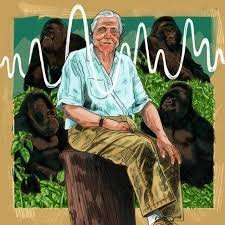
If the termite mound showed his persistence, his encounter with gorillas in the Virunga Mountains of Rwanda revealed his soul. Working with primatologist Dian Fossey, Attenborough abandoned his script to connect with a female gorilla and her infants.
In that moment, he adopted the signature hushed tone that would become his trademark. This whisper wasn’t just a technical choice to avoid startling the animals; it was a gesture of respect. It signaled to the audience that we are guests in a world that does not belong to us, shifting the perspective from human dominance to humble observation.
Adapting to the Anthropocene: From Film to AI
Throughout his career, Attenborough has embraced every technological leap, from the transition to color and 4K drones to recording voiceovers via Zoom in his own dining room. However, the rise of Artificial Intelligence presents a new, more sinister challenge.
The emergence of AI-generated voice clones has disturbed Sir David, as his identity is often stolen to spread misinformation. Yet, experts argue that AI cannot replicate the performance of Attenborough. His delivery is a synergy of deep knowledge, emotional resonance, and a lifetime of witnessing the planet’s fragility—elements that an algorithm simply cannot simulate.
A Final Plea for the Living World
As he enters his centenarian years, the tone of Attenborough’s work has shifted from pure wonder to urgent warning. He has become the voice of the Anthropocene, the era defined by human impact on the environment.
“If we save the sea, we save our world.”
His legacy is not found in the awards or the fame, but in the shift of human consciousness. He has taught us that we are not the center of the universe, but a part of a complex, fragile tapestry. By decentering humanity, David Attenborough has given us the best chance at survival.
For more information on the ongoing efforts to protect biodiversity, visit the BBC Natural History Unit, where the legacy of Attenborough’s storytelling continues to inspire new generations of conservationists.