
Alaska’s 481-Metre Megatsunami: A Stark Warning from the Climate Crisis
Imagine a wall of water so immense that it towers over the Eiffel Tower. This isn’t a scene from a Hollywood disaster movie, but a terrifying reality that recently unfolded in the frozen landscapes of Alaska. A massive megatsunami, reaching a staggering 481 metres (1,578 ft), struck the Tracy Arm fjord, serving as a violent reminder of the planet’s instability in the face of the ongoing climate crisis.
The Day the Fjord Rose: What Happened in Tracy Arm?
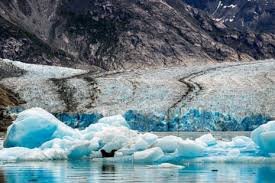
On August 10, 2025, at 5:26 am local time, the tranquility of south-east Alaska was shattered. A colossal rockslide, collapsing 1 km vertically onto the South Sawyer glacier, displaced an astronomical volume of water within the narrow 48km fjord. The result? The second-tallest tsunami ever recorded in human history.
To put this scale into perspective, the wave reached 481 metres, dwarfing the Eiffel Tower’s 330 metres. According to research published in the prestigious journal Science, the event was so powerful it generated seismic waves equivalent to a 5.4 magnitude earthquake and triggered a 36-hour seiche (a standing wave that oscillates within a closed body of water).
A Terrifying Near Miss for Thousands
While there were no fatalities, the timing of the event was chilling. The Tracy Arm fjord is a hotspot for tourism, with approximately three cruise ships passing through daily. Just hours after the landslide, a National Geographic tour boat and another sightseeing vessel from Juneau—each carrying over 100 passengers—were scheduled to enter the fjord.
Dennis Staley from the US Geological Survey (USGS) described the incident as a “historic event,” stating bluntly, “I feel like we dodged a bullet.”
The Climate Connection: Why is This Happening?
This wasn’t a random geological fluke. Scientists, led by Dan Shugar from the University of Calgary, point directly to the climate crisis as the primary catalyst. The mechanism is a dangerous chain reaction:
- n
- Rapid Glacier Retreat: As temperatures rise, glaciers recede, leaving steep valley walls unsupported.
- Permafrost Degradation: Thawing ground destabilizes rock formations.
- Slope Failure: Without the ice to act as a buttress, massive rockslides are triggered, plunging into the sea.
Researchers emphasize that without the rapid retreat of the glacier, this specific landslide likely would not have produced such a devastating wave, as the debris would have collapsed onto the ice rather than directly into the water.
Comparing the Giants: Is This the New Normal?
The Tracy Arm event is only slightly smaller than the world’s tallest tsunami, recorded in Lituya Bay, Alaska, in 1958, which reached 530 metres. However, the frequency of these events is alarming. In recent years, Alaska has seen multiple landslide-generated tsunamis, including a 193-metre wave in Taan fjord in 2015 and another significant event in Kenai fjords national park in 2024.
With cruise passenger numbers in Alaska climbing from 1 million in 2016 to 1.6 million in 2025, the overlap between high-density tourism and unstable geological zones is creating a high-risk environment.
The Path Forward: Mitigation and Monitoring
The scientific community is calling for urgent action to protect local communities and tourists. To prevent a future tragedy, the study suggests:
- n
- Systematic Monitoring: Implementing advanced sensors on unstable slopes.
- Realistic Modelling: Developing new tsunami models that account for landslide-generated waves rather than just earthquake-driven ones.
- Enhanced Protection: Stricter regulations and safety protocols for vessels entering high-risk fjords.
For more information on how global warming is affecting polar regions, you can explore the latest reports from the Intergovernmental Panel on Climate Change (IPCC).



