
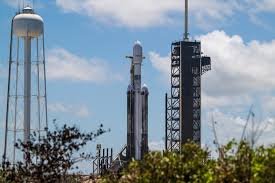
SpaceX Falcon Heavy Rocket Launch: Bringing 4K Streaming to the Skies
Get ready for liftoff! SpaceX is gearing up for another powerhouse mission as the Falcon Heavy rocket prepares to carry the ViaSat-3 F3 satellite into orbit. After a brief weather delay, the aerospace giant is set to deploy the final piece of the ViaSat-3 constellation, promising a revolution in how we connect while traveling at 30,000 feet.
The Mission: Powering the Future of In-Flight WiFi
Launching from the iconic Launch Complex 39A at NASA’s Kennedy Space Center, the Falcon Heavy will utilize a staggering 5.1 million pounds of thrust. The goal? To propel the six-metric-ton ViaSat-3 F3 spacecraft into a geosynchronous transfer orbit.
But this isn’t just about the spectacle of a rocket launch; it’s about a massive leap in digital accessibility. According to Dave Abrahamian, Viasat’s VP of Satellite Systems, this mission is the key to unlocking high-speed internet for airline passengers. We are moving from the days of basic emails to an era where streaming Netflix in 4K is possible mid-flight.
Why the Falcon Heavy is a Game-Changer
While previous satellites in the series were launched using different vehicles, the choice of the SpaceX Falcon Heavy provides distinct advantages over competitors like the Atlas 5. Because of its superior power, the Falcon Heavy can place the satellite into a more favorable transfer orbit.
Key technical advantages include:
- n
- Faster Commissioning: A more efficient orbit means the satellite reaches its operational position faster.
- Electric Propulsion Friendly: The orbit is optimized for the satellite’s onboard electric propulsion systems.
- Precision Deployment: Dropping the spacecraft closer to the geostationary Earth orbit (GEO) reduces the energy required for final positioning.
Advanced Technology: The Phased Array Advantage
The ViaSat-3 F3 is not a traditional satellite. Unlike older models with fixed beams and rigid spectrum allocations, this spacecraft utilizes phased array technology. This allows Viasat to:
- Dynamically form beams wherever demand is highest.
- Allocate spectrum flexibly to avoid “trapped capacity.”
- Provide over 1 Terabit per second (Tbps) of capacity specifically targeting the Asia-Pacific (APAC) region.
The Art of Recovery: Boosters and Logistics
In true SpaceX fashion, the mission highlights the company’s mastery of reusability. The Falcon Heavy’s architecture involves three cores. For this mission:
- Side Boosters: Tail numbers 1072 and 1075 will be recovered at Landing Zone 2 (LZ-2) and Landing Zone 40 (LZ-40).
- Center Core: The brand new booster B1098 will not be recovered and will be discarded in the Atlantic Ocean.
Looking Ahead
As the 12th flight of the Falcon Heavy, this mission cements the rocket’s role as a cornerstone of modern aerospace logistics. For the average traveler, the result will be simple: faster, more reliable, and potentially free high-speed internet in the air, regardless of where they are flying in the APAC region.
Stay tuned for more updates on the frontier of space exploration and satellite technology!



