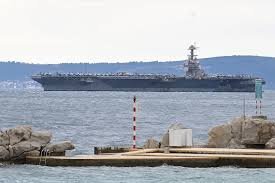
The USS Gerald R. Ford: Redefining Maritime Supremacy
The USS Gerald R. Ford (CVN 78) is not just another aircraft carrier; it is a floating city and a masterpiece of modern engineering. As the lead ship of her class, she represents the most significant leap in naval aviation technology in decades, designed to ensure the United States maintains its strategic edge in an increasingly complex global security environment.
From its massive nuclear-powered engines to its revolutionary launch systems, the USS Gerald R. Ford is built to operate more efficiently, launch more aircraft, and sustain longer deployments than any predecessor.
Cutting-Edge Innovations: What Makes It Different?
The Ford-class carriers introduce several groundbreaking technologies that separate them from the older Nimitz-class ships. The primary goal was to reduce manpower requirements while increasing the sortie generation rate (the speed at which aircraft can be launched and recovered).
1. Electromagnetic Aircraft Launch System (EMALS)
Perhaps the most famous upgrade is the EMALS. Unlike traditional steam catapults, which are prone to wear and tear and provide a violent jolt, EMALS uses electromagnetic energy to propel aircraft. This allows for:
- n
- Greater Precision: Precise control over the launch force, accommodating both heavy fighters and lightweight drones.
- Reduced Maintenance: Fewer moving parts and less mechanical stress on the ship’s hull.
- Increased Flexibility: Faster launch cycles for a higher volume of sorties.
n
n
n
2. Advanced Arresting Gear (AAG)
To complement the EMALS, the Advanced Arresting Gear replaces old hydraulic systems. This digital system can be adjusted in real-time to safely catch aircraft of varying weights and speeds, significantly reducing the risk of landing accidents and airframe stress.
3. Enhanced Power Generation
The USS Gerald R. Ford generates significantly more electrical power than previous carriers. This massive energy capacity is essential for powering the EMALS and provides a future-proof foundation for incorporating directed-energy weapons (lasers) and other high-energy defense systems.
Key Specifications at a Glance
To understand the sheer scale of this vessel, consider these impressive figures:
- n
- Length: Approximately 1,092 feet.
- Displacement: Roughly 100,000 long tons.
- Crew: Designed to operate with about 500 to 1,000 fewer sailors than the Nimitz class.
- Aircraft Capacity: Capable of carrying 75+ aircraft, including the F-35C Lightning II.
- Propulsion: Two A1B nuclear reactors, providing virtually unlimited range.
n
n
n
n
n
Strategic Impact on Global Security
The deployment of the USS Gerald R. Ford sends a clear message of power projection. By integrating stealth capabilities and advanced radar systems, the ship acts as a mobile airbase capable of responding to crises anywhere in the world within days.
Furthermore, its ability to operate the F-35C—the Navy’s stealth fighter—ensures that the U.S. can penetrate contested airspace and maintain air superiority in high-threat environments.
Conclusion: The Future of Naval Warfare
The USS Gerald R. Ford is more than a ship; it is a platform for the future. While its development faced challenges and cost overruns, the resulting technology provides a blueprint for the next century of naval operations.
For those interested in the official technical documentation and current deployments, you can visit the official US Navy website to learn more about the fleet’s mission and capabilities.