
Bondi Beach Tragedy Renews Urgent Calls for Stricter Australian Gun Laws
The serene Sunday afternoon at Bondi Beach, a global icon of Australian beauty, was shattered by an unspeakable act of violence. The recent attack, which tragically claimed the lives of numerous Bondi Beach shooting victims, has sent shockwaves across the nation and around the world, reawakening deeply painful memories of Australia’s deadliest modern mass shooting: the Port Arthur massacre of 1996.
For many Australians, the nearly three-decade-old Port Arthur tragedy, which led to some of the world’s strictest gun laws, felt like a distant, albeit dark, chapter in history. However, the horrific events at Bondi, targeting a Jewish event celebrating Hanukkah, have forced a national reckoning, putting Australia’s much-lauded gun control measures back under the microscope.
The Echoes of Port Arthur: A Nation Remembers
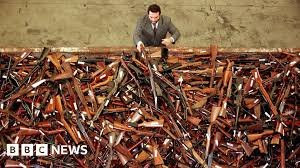
In April 1996, a lone gunman armed with semi-automatic rifles killed 35 people in the Tasmanian tourist town of Port Arthur. This horrific event galvanized a nation and its then-Prime Minister, John Howard, to enact sweeping gun law reforms. These reforms included a national firearms agreement, a ban on automatic and semi-automatic rifles and shotguns, and a massive gun buyback scheme that saw over 650,000 firearms voluntarily surrendered and destroyed.
Roland Browne, a leading gun control advocate, remembers that time vividly. He was actively lobbying for firearm bans when the Port Arthur massacre unfolded. Now 66, Browne found himself grappling with a profound sense of déjà vu upon hearing of the Bondi attack. “There’s just a lot of similarities,” Browne, who spent childhood summers in Bondi, told the BBC. “They’re both very public places frequented by tourists from around the nation and around the world.”
Browne’s disappointment is palpable: “It’s sickening and I’m bitterly disappointed in our political system whereby the voices for tighter gun laws and public health aren’t listened to until there’s a major event like this.”
Australia’s Gun Law Paradox: A Beacon Under Scrutiny
For decades, Australia has been praised globally for its stringent gun laws, often contrasted with countries like the United States where personal protection is a primary reason for gun ownership, leading to significantly higher rates of gun violence. The UK, too, introduced stricter controls after its own tragedy in Dunblane just a month before Port Arthur.
Yet, the reality in Australia is not as clear-cut as its international reputation suggests. A recent report by the Australia Institute revealed a startling statistic: there are now over four million privately-owned firearms across the country, nearly double the number from two decades ago. This equates to roughly one gun for every seven Australians.
The report also dispels the myth that guns are primarily rural possessions, showing their widespread presence in metropolitan and suburban areas. Furthermore, while the overall number of guns has risen, it’s concentrated in fewer hands, with each license holder owning an average of more than four firearms.
The Policy Debate: Caps, Radicalization, and Loopholes
This surge in firearms fuels the core debate. Roland Browne advocates for a national cap of one to three guns per license, depending on the category. He points to Western Australia as the only jurisdiction with such a cap, where new laws introduced in March limit owners to between five and ten firearms. Authorities confirmed that one of the alleged Bondi gunmen, Sajid Akram, owned six registered guns under a recreational hunting license – a category Browne believes should be abolished due to its ambiguous definition.
Conversely, Tom Kenyon, chief executive of the Sporting Shooters Association of Australia, argues that such caps are “meaningless.” He asserts that limiting gun numbers wouldn’t have prevented the Bondi attack, as the alleged perpetrators were “radicalized.” Kenyon references the 2016 Nice attack in France, where a truck was used as a weapon, to suggest that individuals intent on harm will find alternative means. Prime Minister Anthony Albanese confirmed that the other alleged Bondi gunman, Naveed Akram, had been previously investigated for links to extremist ideologies.
Adding to the complexity are inconsistencies in Australia’s gun laws across states and territories. While general requirements include being over 18, a “fit and proper person,” passing safety courses, and providing a “genuine reason” for ownership (e.g., recreational hunting, sport shooting, work, farming), loopholes exist. Minors in various jurisdictions, for instance, can access firearms under supervision, and some gun types are banned in one state but legal elsewhere.
Swift Government Action and Unfinished Business
In the immediate aftermath of the Bondi shooting, both NSW Premier Chris Minns and Prime Minister Anthony Albanese reacted decisively. Premier Minns questioned the need for “massive weapons” for non-farmers, while Albanese hosted an emergency meeting, leading to a pledge for tightened gun laws across the country. Less than 24 hours after the tragedy, Albanese announced a national gun buyback scheme – the first of its scale since 1996 – along with proposals for regular reviews of license holders, acknowledging that “people can be radicalised over a period of time.”
However, John Howard, the architect of the 1996 reforms, cautioned against viewing stricter gun laws as a sole solution, suggesting it could be a “diversion” from the underlying issue of rising antisemitism. Kenyon echoed this, arguing that resources would be better spent combating radicalization and improving intelligence sharing.
A critical piece of unfinished business from the 1996 reforms, a national firearms register, is still not operational, with authorities now prioritizing its creation after the Bondi attack and a prior fatal shooting in Wieambilla. The delay in this vital database highlights the ongoing challenges in ensuring comprehensive public safety.
A Collective Commitment for the Future
The human cost of these events is immeasurable. Walter Mikac, whose wife and two young daughters were among the Port Arthur massacre victims, founded the Alannah and Madeline Foundation in their honor. He described the Bondi shooting as a “horrific reminder” that Australia’s gun laws must continuously protect everyone. “After Port Arthur, Australia made a collective commitment to put community safety first, and that commitment remains as important today as ever,” he stated.
Roland Browne concurs, emphasizing the need for gun law reforms to “keep up-to-date with changing community attitudes, technological advances and to rectify identified deficiencies.” While mass shootings remain rare in Australia, incidents involving firearms, from neighborhood disputes to gang violence, persist. Browne attributes this to “guns being in the wrong hands, a legacy of poor storage allowing guns to be stolen and sold – and thus move into black markets.”
The tragedy at Bondi Beach is a complex culmination of factors, urging Australia to not only address the presence of firearms but also enhance the assessment of license holders and enforce more stringent rules on the types of guns legally available. It’s a painful reminder, as Browne eloquently puts it, that “it’s sad that it takes such a tragedy to get people to wake up and listen.” Australia’s commitment to public safety, born from past horrors, is once again being tested and reinforced.



