
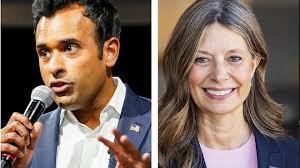
A Watershed Moment for Ohio Politics
For the first time in the history of the Buckeye State, the major party ballots for governor are shaping up to exclude the traditional profile of a white Christian man. This historic shift brings a fascinating, yet complex, political dynamic to the forefront as Vivek Ramaswamy and Amy Acton prepare for a battle that transcends simple policy debates.
While the election should ideally be a contest of ideas and governance, the reality is that identity—race, gender, and religion—continues to play a pivotal role in how voters perceive their candidates. This race serves as a societal mirror, reflecting the deep-seated biases that still linger within the electorate.
The Vivek Ramaswamy Paradox: MAGA Loyalty vs. Racial Bias
Vivek Ramaswamy, a billionaire and son of Indian immigrants, represents a unique paradox within the Republican party. Despite having the endorsement of Donald Trump and positioning himself as a fierce critic of Diversity, Equity, and Inclusion (DEI) programs, Ramaswamy faces an uphill battle with a specific segment of his own base.
In rural Ohio, where loyalty to the MAGA movement is absolute, some voters struggle to reconcile their political alignment with their personal prejudices. The challenge for Ramaswamy is not a lack of conservative credentials, but rather a deep-seated mistrust of non-white candidates among far-right voters.
The Extremist Fringe
The presence of candidates like Casey Putsch—who has been linked to admiration for Adolf Hitler—highlights the volatile nature of the current political climate. While Putsch has little chance of defeating Ramaswamy, his rhetoric appeals to the very biases that could potentially erode Ramaswamy’s support among the most xenophobic elements of the GOP.
Ramaswamy has not remained silent on this issue. In a poignant New York Times opinion piece, he explicitly condemned white nationalist rhetoric, stating that those who harbor such animus have no place in the modern conservative movement.
Amy Acton and the Glass Ceiling in Ohio
On the Democratic side, Amy Acton faces a different but equally daunting set of hurdles. As a Jewish woman, Acton enters a race in a state that has famously struggled to elect women to its highest office. Aside from a brief 11-day transition period by Nancy P. Hollister in the late 90s, Ohio has never truly elected a female governor.
Acton’s candidacy is likely to encounter traditional sexist tropes, where female leaders are unfairly labeled as “unstable” or “weak.” This gender bias, combined with potential antisemitism, adds another layer of complexity to her path toward victory.
Policy vs. Prejudice: The Final Verdict
As the 2026 race approaches, Ohioans are faced with a critical choice. The candidates offer contrasting visions for the state, but the real question is whether the voters will prioritize policy over identity.
- Vivek Ramaswamy: Proposing a shift away from DEI and a return to “meritocracy,” while fighting for acceptance within a racially divided base.
- Amy Acton: Navigating the historic gender gap in Ohio politics while presenting a Democratic alternative.
Ultimately, the results of this election will reveal more than just who will lead the state; they will reveal whether Ohio is ready to move past the prejudices of the past or if the “old guard” of racial and gender biases still dictates the political landscape.



