
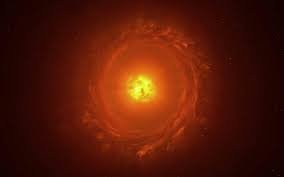
WOH G64: The Celestial Giant on the Brink of Self-Destruction
In the vast expanse of our neighboring galaxy, a cosmic drama is unfolding. Astronomers have spent decades monitoring WOH G64, one of the largest known stars in the universe. Recent findings suggest that this behemoth is undergoing a violent transformation, signaling that it may be heading toward a spectacular end.
A groundbreaking study led by Gonzalo Muñoz-Sanchez at the National Observatory of Athens, published in Nature Astronomy, reveals that WOH G64 has transitioned from a red supergiant to a rare yellow hypergiant. This shift is more than just a change in colour; it is a sign that the star is preparing for a supernova explosion.
What Exactly is WOH G64?
Discovered in the 1970s within the Large Magellanic Cloud (a dwarf galaxy orbiting our own Milky Way), WOH G64 is a monster of the cosmos. To put its size into perspective, its radius is more than 1,500 times that of our Sun.
Unlike our Sun, which is billions of years old and evolves slowly, WOH G64 is a “live fast, die young” kind of star. Estimated to be less than 5 million years old, it was born from a massive collapse of gas and dust, igniting into a luminous powerhouse that burned through its fuel at an alarming rate.
The Dramatic Shift: From Supergiant to Hypergiant
For years, WOH G64 was classified as a red supergiant. However, data from 2014 indicates a sudden and dramatic change. The star has begun shedding its outer layers, causing it to shrink and heat up—transitioning it into the elusive category of a yellow hypergiant.
Why is this happening? Scientists propose two main theories:
- n
- Companion Interaction: The presence of a companion star may have triggered the ejection of WOH G64’s surface layers.
- Pre-Supernova “Superwind”: The star might be experiencing internal pulsations as its core fuel is exhausted, creating a massive wind that blows away its outer shell.
A Rare Glimpse into Stellar Death
In 2024, the Very Large Telescope Interferometer (VLTI) captured the first detailed image of a star beyond our galaxy. The image revealed a dense, dusty cocoon surrounding WOH G64, confirming that the star is aggressively losing mass as it ages.
Witnessing this process in real-time is an extraordinary opportunity for the scientific community. While most stars take millions or billions of years to evolve, the transition of WOH G64 provides a live case study on how the most massive stars in the universe die.
What Happens Next?
Once a star becomes a hypergiant, its fate is sealed. The only logical conclusion is a supernova—a fiery, cataclysmic explosion that will scatter heavy elements across space, potentially seeding the birth of future solar systems.
If we are lucky, astronomers may document the actual explosion within our lifetime. Such an event would not only be a breathtaking intergalactic spectacle but would also provide critical data to complete the puzzle of stellar evolution.
Want to stay updated on the latest discoveries in space and astrophysics? Keep following our news for more updates on the wonders of the cosmos.



