
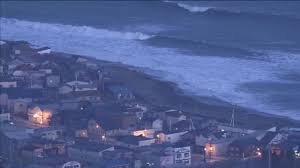
Urgent Tsunami Alert in Japan Following Powerful Magnitude 7.7 Earthquake
Japan has once again been put on high alert after a violent earthquake struck the northern part of the archipelago on Monday. What began as a magnitude 7.4 tremor was later re-evaluated to a powerful 7.7 magnitude seismic event, triggering immediate tsunami warnings and sparking fears of an even larger disaster.
The quake originated in the Pacific waters off the coast of the Iwate Prefecture at 4:53 PM local time. The intensity of the shaking was so severe that large buildings in Tokyo—hundreds of kilometres from the epicentre—swayed for over a minute, causing widespread alarm across the capital.
Immediate Impact and Tsunami Observations
The Japan Meteorological Agency (JMA) acted swiftly, issuing a tsunami alert as waves were expected to hit coastal regions. Shortly after the tremor, the following was observed:
- n
- Kuji Port (Iwate): A tsunami wave of 80 centimetres was recorded at 5:34 PM.
- Initial Surge: A first wave of 70 centimetres hit just minutes prior.
- Government Action: Prime Minister Sanae Takaichi’s office immediately activated a crisis management cell to coordinate emergency responses.
Authorities and the national broadcaster, NHK, urged residents to “evacuate immediately to higher ground or designated evacuation buildings,” warning that tsunami waves often strike multiple times and that safety cannot be guaranteed until the alert is officially lifted.
The Looming Threat: Could a Mega-Quake Follow?
While the initial shock has passed, the danger is far from over. The government has warned of an increased risk of a magnitude 8.0 or higher earthquake occurring in the region. Although not certain, officials are urging the public to maintain strict disaster preparedness measures.
The JMA has advised citizens to remain vigilant for aftershocks over the coming week, noting that the most dangerous tremors often occur within the first two to three days following a major event.
A Nation Haunted by the 2011 Tragedy
For the people of Japan, these alerts trigger deep-seated trauma from the March 2011 Great East Japan Earthquake. That magnitude 9.0 disaster generated a catastrophic tsunami that claimed approximately 18,500 lives.
Much of the current anxiety centres on the Nankai Trough, an 800-kilometre submarine trench where the Philippine Sea Plate slides beneath the continental plate. Experts warn that a “mega-quake” in this zone could lead to devastating casualties and trillions of dollars in damages.
Why Japan is a Seismic Hotspot
Japan’s geographic location makes it one of the most seismically active countries in the world. It sits at the junction of four major tectonic plates on the western edge of the Pacific Ring of Fire. With roughly 1,250 tremors recorded annually, the nation has developed some of the world’s most advanced early-warning systems and building codes to mitigate risk.
For real-time updates on seismic activity, residents and travellers are encouraged to monitor the Japan Meteorological Agency (JMA) official portal.



