
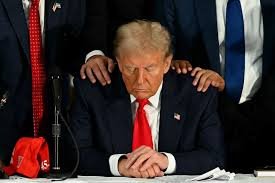
The Intersection of Faith and Governance in the Oval Office
In a move that further blends religious devotion with official state business, President Donald Trump is set to participate in a high-profile public Bible reading this week. As part of the “America Reads The Bible” initiative, the President will deliver a video message from the Oval Office on April 21, marking another step in the administration’s effort to integrate Christian faith into the fabric of US governance.
The Significance of 2 Chronicles 7:14
The President is scheduled to read a specific passage from 2 Chronicles 7:11-22. Of particular importance is verse 14, a cornerstone for many religious nationalists, which states:
“If my people, which are called by my name, shall humble themselves, and pray, and seek my face, and turn from their wicked ways; then will I hear from heaven, and will I forgive their sin, and will I heal their land.”
This particular verse has deep roots in the current political climate. It was famously cited by the founder of “Cowboys for Trump” during the events of January 6, 2021, and has been used by evangelists like Anne Graham Lotz since Trump’s 2016 victory to frame his presidency as a divine appointment.
A Tightrope of Tradition and Controversy
Trump’s participation comes at a time of significant religious and diplomatic tension. Recently, the President has been embroiled in a public feud with Pope Leo over the conflict in Iran. The clash highlighted a sharp divide in perspectives on nuclear weapons and diplomacy, with the Pope stating he has “no fear” of the administration.
Adding to the controversy was a recent social media incident where Trump posted—and subsequently deleted—an AI-generated image depicting himself as Jesus. While critics labeled it as blasphemy, the President defended the image, claiming he believed it depicted him as a doctor intended to “make people better.”
Blurring the Line Between Church and State
Political analysts and historians are raising concerns about the erosion of the traditional wall between church and state. Margaret Susan Thompson, a professor at Syracuse University, notes that while past presidents like Jimmy Carter and George W. Bush were guided by their faith, they did not attempt to make that faith a mandatory national doctrine.
The current administration’s approach is notably more systemic, featuring several key initiatives:
- n
- National Prayer Calls: Requests for citizens to pray for an hour a week.
- Government Social Media: Integration of Bible verses and Christian imagery on official accounts.
- Pentagon Prayer Services: Defense Secretary Pete Hegseth has been a driving force in bringing scripture into the Department of Defense, even inviting controversial figures to lead services.
The Influence of Key Officials
The “America Reads The Bible” event will not be a solitary effort. High-ranking officials, including Secretary of State Marco Rubio, Defense Secretary Pete Hegseth, and Chief of Staff Susie Wiles, are expected to join the President. Hegseth, in particular, has been vocal in his use of religious rhetoric, recently comparing journalists to the biblical Pharisees during a briefing on the Iran war.
As the administration continues to weave religious identity into official policy, the United States finds itself at a crossroads, questioning the balance between individual faith and the secular mandates of a democratic republic.



