
Ukraine’s Drone Strikes Cripple Russian Oil Profits
Ukraine has significantly escalated its attacks on Russian territory, employing an unprecedented number of drones to target critical oil and gas infrastructure. These strikes are not only disrupting Russia’s energy sector but also denying the Kremlin substantial windfall profits, prompting warnings to European nations supporting Ukraine’s drone production.
Escalating Tensions and Russian Warnings
Recent Ukrainian successes, bolstered by agreements with European defence companies, have triggered a strong reaction from Russia. The Russian defence ministry issued a statement on Wednesday, condemning the support as a “deliberate step leading to a sharp escalation of the military and political situation” and accusing European countries of becoming a “strategic rear for Ukraine.” Russia even published a list of European companies involved in joint weapons production, hinting at potential retaliation. Dmitry Medvedev, a former Russian president, explicitly labelled the list as “potential targets for the Russian armed forces.”
Western Support Fuels Ukraine’s Capabilities
Germany has pledged a significant investment of 300 million euros ($355m) to enhance Ukraine’s long-range strike capabilities, alongside a separate investment in 5,000 mid-range attack drones. Norway has committed to joint drone production and a 560 million euro ($661.5m) donation for drone support on the front lines. The Netherlands and Belgium have also contributed substantial funding, with 248 million euros ($293m) and 85 million euros ($100m) respectively, dedicated to drone support.
Impact on Russian Oil Revenue
While global oil companies enjoyed a $23 billion windfall profit in March due to disruptions caused by the Iran war, Russia’s share of these profits has been significantly eroded by Ukraine’s targeted strikes. Reports indicate that Ukraine’s attacks have destroyed Russia’s ability to export at least 2 million barrels of oil per day, resulting in a 40 percent reduction in potential revenue. Targets have included drilling platforms, pipelines, pumping stations, offloading terminals, and refineries.
Recent Strike Locations
In the past week alone, Ukrainian strikes have hit:
- Two drilling platforms in the northern Caspian Sea
- Two oil pumping stations in Volgograd and Krasnodar Krai
- An oil depot in Tver, northwest of Moscow
- The Cherepovets Azot ammonia plant in the Volga region
- The Sterlitamak Petrochemical Plant in the Republic of Bashkortostan
- The oil export terminal and refinery at Tuapse on the Black Sea
These strikes have been independently verified through geolocated video footage and confirmations from Russian officials.
Ukraine’s Expanding Arsenal
Ukrainian President Volodymyr Zelenskyy has highlighted the increasing frequency and reach of these deep strikes, emphasizing Ukraine’s growing capabilities. He recently showcased 56 types of Ukrainian-built weapons, including 31 types of drones, demonstrating a more than 50-fold increase in the Ukrainian defence industry’s capabilities since the start of the full-scale invasion.
Damage to Key Infrastructure
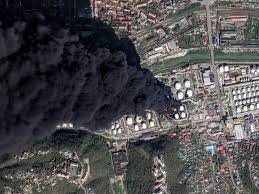
The most significant damage occurred between March 22nd and April 10th, particularly at the Baltic ports of Primorsk and Ust-Luga. Satellite imagery suggests Primorsk lost 40% of its storage facilities, while Ust-Luga lost 30%. Novatek, a Russian energy company, suspended gas condensate processing and exports at Ust-Luga. Shipments from both ports were severely curtailed, with activity reduced to “individual vessels” compared to a weekly average of 40-50. A subsequent attack on Ust-Luga on April 5th ignited three 20,000-cubic-metre storage tanks. Simultaneous strikes targeted Primorsk and the Sheskharis oil terminal, damaging a Kalibr missile-carrying frigate, the Admiral Makarov. Industry sources estimate at least $200 million worth of oil has been burned in Primorsk alone.
Strategic Targeting and Justification
On April 8th, Ukraine targeted Russia’s largest oil terminal in occupied Crimea, Feodosia, a key supply route for front-line troops. Zelenskyy has justified these attacks, stating that “only significant financial losses force Russia to consider a scenario of abandoning this war.”
Follow Al Jazeera English for continued coverage.



