
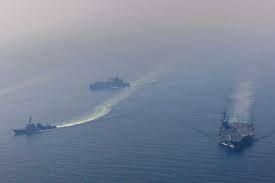
Strait of Hormuz US Blockade: A High-Stakes Gamble
The U.S. Navy has initiated a significant operation near the Strait of Hormuz, raising critical questions about its sustainability and potential outcomes. History demonstrates that naval blockades are notoriously difficult to enforce and often yield unpredictable results. The White House aims to curtail Iran’s primary revenue source – oil exports – by disrupting its access to global maritime trade, a move intended to escalate economic pressure following recent U.S. military actions.
What is the Nature of the Operation?
CENTCOM has stated its intention to intercept vessels traveling to and from Iranian ports, while affirming it will not impede navigation for ships utilizing other Persian Gulf ports. President Trump has explicitly linked this effort to strangling Iran’s petroleum export capabilities. While the administration terms this a “blockade,” experts like Bryan Clark of the Hudson Institute suggest it’s more accurately described as a naval quarantine, as the U.S. is primarily targeting traffic originating from Iran.
A New Phase in Economic Pressure
Eric Schuck, an economics professor at Linfield University, views this tactic as a continuation of long-standing U.S. sanctions against Iran. The core principle behind this strategy is to identify and sever access to “something which is nonsubstitutable, something that is so essential to their economy that everything else is going to come to a halt.” In Iran’s case, that critical element is oil.
Lessons from History: The Challenges of Naval Blockades
Throughout history, naval blockades have relied on coordinated patrols, control of key routes, and strategic ship positioning. During the French Revolutionary and Napoleonic Wars, Britain imposed blockades on French ports, demanding a substantial commitment of the Royal Navy. Even then, nimble French vessels managed to evade the British screen.
However, the U.S. Navy possesses capabilities unavailable to historical navies. Steve Dunn, author of Blockade: Cruiser Warfare and the Starvation of Germany in World War One, notes the advantages of modern technology: “Detection of vessels is much easier, with satellite, [planes and drones] and radar.” This allows for more effective monitoring and the deployment of boarding parties to assess vessel compliance.
Logistical Hurdles and Enforcement Difficulties
Despite technological advancements, enforcing a blockade presents significant logistical challenges. Clark estimates that “six or so destroyers in rotation” would be required to effectively monitor the Strait of Hormuz. Considering the average of 138 ships that previously transited the strait daily, he argues that “it would be almost impossible [for the Navy] to keep up with that traffic volume.”
The early stages of the Ukraine war offer a parallel example. Russia’s attempt to blockade Ukrainian ports in the Black Sea, using mines and warships, was ultimately “quite quickly negotiated away” due to Russia’s limited capacity for sustained enforcement, according to Nicholas Mulder, a professor at Cornell University specializing in sanctions and economic warfare. “That’s the difficult thing about blockades — you have to enforce them,” Mulder emphasizes.
The Mechanics of Enforcement
Enforcing a blockade requires a naval force to intercept and redirect or detain vessels. Clark explains that the U.S. Navy would likely “intercept [ships] and basically get in their way and force them to turn … or take them over to a marshaling area or an anchorage in Oman.” However, he doubts the U.S. will engage in a “scorched-earth campaign” of attacking every vessel attempting to evade the blockade.
Historical Parallels: Successes and Failures
World War II provides contrasting examples. Germany’s U-boat campaign against Britain aimed to cripple the British war economy through unrestricted submarine warfare, but Britain managed to maintain its vital North Atlantic supply line. Conversely, the U.S. submarine campaign against Japan proved “brutally effective,” disrupting oil and resource flows from the Dutch East Indies, forcing Japan to reallocate its fleet and ultimately contributing to its economic collapse.
Unintended Consequences and Broader Impacts
Schuck cautions that naval blockades often have unintended consequences. During World War I, the Allied blockade of Germany inadvertently disrupted fertilizer production, leading to agricultural failures and civilian malnutrition. Similarly, the British blockade of French ports in the early 19th century devastated French trade and its economy. In Iran’s case, disrupting oil revenue could potentially jeopardize its food supply.
As Schuck concludes, “In most cases, what we’re aiming at and what we actually break are two different things.” The success of the U.S. strategy in the Strait of Hormuz remains uncertain, and its potential ramifications extend far beyond Iran’s borders.
Learn more about international trade and geopolitical strategy at: Council on Foreign Relations



