International Space Station: Unveiling Earth’s Hidden Electrical Storms
While we on Earth typically witness storms as flashes of lightning and cracks of thunder, a hidden world of electrical activity unfolds far above our heads. These spectacular, yet elusive, phenomena – known as transient luminous events (TLEs) – were once only glimpsed in pilots’ anecdotes and lucky photographs. Now, thanks to the unique vantage point of the International Space Station (ISS), scientists are finally unlocking the secrets of these breathtaking displays.
What are Transient Luminous Events?
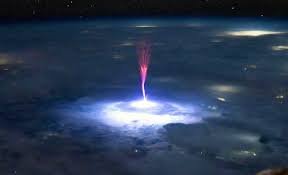
TLEs encompass a range of electrical fireworks occurring in the upper atmosphere, up to 55 miles overhead. These include blue jets, red sprites, violet halos, and ultraviolet rings. For decades, they remained largely unstudied due to their fleeting nature and high altitude. The ISS provides an unobstructed view, allowing specialized cameras and sensors to capture every spark.
ASIM: The ISS’s Sky-Watching Mission
The centerpiece of this research is the Atmosphere–Space Interactions Monitor (ASIM), a European Space Agency instrument attached to the ISS since 2018. ASIM’s mission is to observe Earth and record even the smallest, shortest-lived flashes. Its high-speed cameras and photometers have already exceeded expectations, revealing fascinating details about these events.
ELVES and Corona Discharges
Data from ASIM show that lightning-like discharges can generate enormous rings of ultraviolet light called ELVES, potentially disrupting long-distance radio signals. The monitor has also catalogued ultra-brief corona discharges, helping researchers understand how clouds prepare for full-blown lightning strikes.
Red Sprites and Blue Jets
Mysterious red sprites, resembling upside-down jellyfish, appear in the mesosphere for mere milliseconds. Blue jets shoot upwards from cloud tops with eerie silence. ASIM’s ability to capture these events from orbit has confirmed their altitude and provided valuable data for storm-charging models, ultimately informing aviation safety guidelines.
The ISS Cupola and Thor-Davis Experiment
The ISS cupola, with its seven windows, has become a crucial part of the scientific toolkit. Through ESA’s Thor-Davis experiment, astronauts use a state-of-the-art camera to capture storms at up to one hundred thousand frames per second. The resulting slow-motion footage reveals electrical filaments behaving in ways previously unseen, validating laboratory plasma tests.
Mapping Invisible Hazards: Terrestrial Gamma-Ray Flashes
Lightning storms also produce terrestrial gamma-ray flashes – pulses of radiation that could pose a hazard to aircraft. The Japan Aerospace Exploration Agency’s Light-1 CubeSat, deployed from the ISS, is mapping these invisible hazards, aiming to create a three-dimensional atlas of gamma-ray flash activity.
Why Study TLEs?
These aren’t just meteorological curiosities. TLEs occur in the same charged layers that carry radio waves and relay signals, potentially disrupting communications. Understanding them is crucial for airline safety, particularly on polar and equatorial routes. Furthermore, TLEs influence atmospheric chemistry and radiative balance, impacting climate models.
The Future of Storm Research from Space
With the ISS expected to remain operational for years to come, ASIM and future instruments will continue to build a comprehensive library of these once-invisible events. Engineers are developing next-generation detectors with faster recording speeds and broader spectral coverage. The ISS demonstrates that a unique perspective – looking down from above – is essential for truly understanding Earth’s weather and mitigating the electrical surprises storms can deliver.