
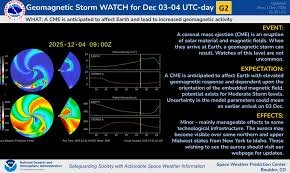
The cosmos is buzzing with activity! Earth is bracing for a “glancing blow” from a recent solar event, leading the Space Weather Prediction Center (SWPC) — part of the National Oceanic and Atmospheric Administration (NOAA) — to issue a G2 (Moderate) geomagnetic storm watch for December 3rd and 4th (UTC days).
What Triggered This Space Weather Event?
On December 1st, an impressive X1.9 solar flare erupted from Region 4299 on the Sun. This powerful flare was accompanied by a significant Coronal Mass Ejection (CME). While the majority of the ejected solar material was directed east of the Sun/Earth line, the SWPC predicts that a portion of this plasma cloud is still on a trajectory that will interact with our planet’s magnetic field.
Understanding a Coronal Mass Ejection (CME)
A CME is a massive burst of solar wind and magnetic fields released from the Sun’s corona into space. Think of it as a giant, energetic bubble of plasma. When these bubbles interact with Earth’s magnetosphere, they can cause a geomagnetic storm, leading to various effects.
What Does a G2 (Moderate) Geomagnetic Storm Mean for Earth?
A G2 level storm is considered moderate on the geomagnetic storm scale (G1 to G5). While not severe, it still carries potential implications. According to the Space Weather Prediction Center, some of the possible impacts include:
- Beautiful Auroras: Increased chances to see the Aurora Borealis (Northern Lights) at higher latitudes, and potentially visible further south than usual. Canadians in particular might get a spectacular show!
- Minor Power Grid Fluctuations: Minor impacts on power systems are possible, though widespread outages are unlikely.
- Satellite Operation Impacts: Satellite operations might experience minor disruptions, particularly for those in low-Earth orbit.
- HF Radio Communication: High-frequency radio communication at higher latitudes could be intermittently degraded.
The exact timing of the CME’s arrival and subsequent impact on Earth’s magnetic field carries some inherent uncertainty, which is typical for such space weather phenomena. However, the watch is a proactive measure to keep relevant sectors informed and prepared.
Staying Informed on Space Weather
For the latest updates and detailed forecasts on space weather, the National Oceanic and Atmospheric Administration (NOAA) and its Space Weather Prediction Center (SWPC) remain the definitive authorities. They continuously monitor the Sun for activity that could affect Earth, from solar flares to CMEs and solar radiation storms.
So, keep an eye on the sky – especially if you’re in Canada or other high-latitude regions – for a potential celestial light show, and rest assured that organizations like NOAA are diligently tracking these natural phenomena to ensure public safety and mitigate potential disruptions.



