
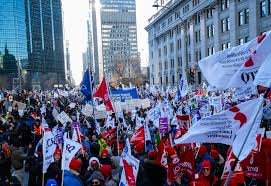
Montreal’s streets vibrated with the collective voice of discontent as tens of thousands of people marched through the city’s core, making a powerful statement against the Legault government and its controversial reforms to the union system. The protest, a vibrant yet defiant display of solidarity, saw drums, trumpets, and slogans echo along René-Lévesque Boulevard, converging at Place du Canada, the starting point for the massive demonstration.
Magali Picard: A Resolute Voice Against Government Policy
At the heart of this formidable mobilization was Magali Picard, president of the Fédération des travailleurs et travailleuses du Québec (FTQ), who delivered a stirring address before an immense crowd filling McGill College Avenue. Her words resonated deeply, challenging the government’s approach to labour relations and worker rights. “To those who don’t like my tone: my tone will change when the attacks cease!” she declared, referencing recent media criticisms from Labour Minister Jean Boulet regarding her “bellicose” stance.
Ms. Picard has been an outspoken critic, notably accusing the Legault government of attempting to muzzle unions during parliamentary committee hearings on Bill 3. In a rare and symbolic gesture, she notably declined to shake Minister Boulet’s hand, underscoring the deep divisions and frustration within the labour movement.
Thousands Demand Action: Beyond Union Reforms
Organized by a coalition of major unions, including the CSN (Confédération des syndicaux nationaux), FTQ, CSQ (Centrale des syndicats du Québec), and CSD (Centrale des syndicats démocratiques), alongside numerous community groups, the march drew an estimated 50,000 participants. Buses from across Quebec, Ontario, and New Brunswick transported demonstrators, highlighting the widespread concern.
While the atmosphere was often festive, the underlying message was one of profound dissatisfaction. Protesters wielded signs bearing blunt messages like, “The CAQ is moving right, we’ll turn the CAQ around!” and “CAQ, you’re getting a hard slap!”
Beyond the direct impact on unions, demonstrators voiced strong opposition to public service cuts and the chronic underfunding of social programs. Geneviève Lamarche, coordinator of the Coalition Solidarité Santé, articulated a common sentiment, stating that the CAQ government rules from an “ivory tower” and “does not understand what is happening on the ground.” She added, “On the ground, people are becoming increasingly poor, they can no longer pay their rent, they do not have access to services, and community organizations are increasingly stifled.”
Françoise Gauthier, CSN’s executive secretary, shared a personal anecdote illustrating the impact of these cuts. Her spouse, who is losing autonomy, recently broke an arm. “We were supposed to get help from the CLSC, but there is none for us. If we want seniors to stay at home as long as possible, we must fund home services,” she emphasized.
Key Legislation Under Fire: Bill 3 and Bill 14
A central focus of the protest was the government’s proposed legislation. Bill 3, introduced by Labour Minister Jean Boulet, aims to make a portion of union dues optional and impose audited financial statements even on smaller unions, potentially cutting their operating budgets by thousands of dollars. These optional contributions would fund activities beyond worker defence, such as organizing demonstrations or legal challenges. The bill also mandates a 24-hour voting period for authorizing strikes or signing collective agreements.
Minister Boulet defends these measures, asserting they are more democratic and empower workers. “The goal is not to muzzle, as I am often accused of wanting to do, but to give workers who pay union dues the ability to influence and express themselves,” he stated recently.
However, Magali Picard and other union leaders argue that Bill 3 aims to weaken the labour movement. Picard has even suggested that a “social strike” could be the ultimate recourse if the CAQ continues to create a climate that she described as “almost a dictatorship.”
Unions also object to Bill 14, which grants the Labour Minister the right to impose mandatory minimum services during strikes or lockouts if the pressure tactic is deemed to pose a serious risk of prejudice to the population. Ruba Ghazal, co-spokesperson for Québec Solidaire, marched with the workers, stating, “We have never needed the union movement as much as we do today… This is why we are here, to also defend our democracy, which is undermined by liberticidal laws, by laws that threaten freedom of expression.”
A Call for Solidarity and Democracy
The Montreal demonstration, which proceeded peacefully save for one arrest for assault, represented a powerful show of unity from a wide array of labour organizations and community groups. It underscored the deep chasm between the Legault government and a significant portion of Quebec’s working population.
As the debate surrounding these crucial reforms continues, the leadership of figures like Magali Picard remains vital. The labour movement stands firm in its commitment to protecting worker rights, ensuring fair public services, and upholding democratic principles in Quebec.



