
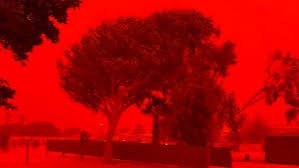
The recent passage of Tropical Cyclone Narelle off the coast of Western Australia wasn’t just a meteorological event; it painted the skies with an unforgettable, fiery hue. Reports flooded social media showcasing vibrant red skies, prompting widespread curiosity about the connection between the cyclone and this dramatic atmospheric display. But what exactly causes a red sky during a tropical cyclone like Narelle?
The Science Behind the Red Skies
The phenomenon is rooted in a combination of atmospheric optics and the unique conditions created by a powerful cyclone. Here’s a breakdown:
- Dust and Salt Particles: Tropical cyclones stir up vast amounts of dust and salt particles from the ocean and land. These particles are carried high into the atmosphere.
- Low-Angle Sunlight: As the sun sets (or rises), its light travels through a greater distance of the atmosphere.
- Rayleigh Scattering: This is the key process. Shorter wavelengths of light (blue and green) are scattered away by the atmospheric particles. Longer wavelengths (red and orange) are less affected and can penetrate through the atmosphere to reach our eyes.
- Cyclone’s Influence: The intense winds of a cyclone like Narelle lift a particularly high concentration of these particles, intensifying the scattering effect and resulting in a more pronounced red colour.
Essentially, the cyclone acts as a giant atmospheric filter, enhancing the natural process of Rayleigh scattering. The more particles suspended in the air, the more dramatic the red colour becomes. It’s a beautiful, albeit indirect, consequence of a powerful weather system.
Tropical Cyclone Narelle: A Brief Overview
Tropical Cyclone Narelle formed in the Indian Ocean in January 2023 and rapidly intensified into a Category 3 cyclone. While it didn’t make direct landfall in Western Australia, it brought strong winds, heavy rainfall, and significant wave heights to coastal areas. The cyclone’s impact was felt across a wide region, and the associated red skies became a captivating visual reminder of its power. You can find more information about the cyclone’s track and intensity from the Bureau of Meteorology (BOM).
Is a Red Sky a Sign of Severe Weather?
While a red sky can be visually stunning, it’s not always a direct indicator of immediate severe weather. However, the conditions that create a red sky – high concentrations of particles in the atmosphere – often *accompany* severe weather events like cyclones, dust storms, and wildfires. Therefore, it’s wise to stay informed about weather forecasts and warnings, especially when witnessing such a spectacle. The Environment Canada provides reliable weather information.
The red skies linked to Tropical Cyclone Narelle served as a striking example of how weather events can create breathtaking natural phenomena. It’s a reminder of the power and beauty of our planet’s atmosphere, and the interconnectedness of weather systems.



