
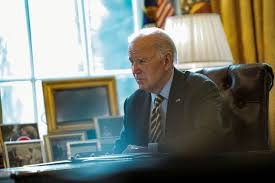
Donald Trump’s Bold Challenge to Joe Biden’s Executive Orders and the Autopen Debate
In a striking move that has sent ripples through the political landscape, former President Donald Trump has reignited a contentious debate surrounding the legitimacy of actions taken during Joe Biden‘s presidency. Trump, known for his direct and often provocative statements, declared on his Truth Social platform his intent to ‘cancel all executive orders, and anything else that was not directly signed’ by him, specifically targeting documents signed by Joe Biden using an autopen.
This audacious declaration raises significant questions about presidential authority, the legal limits of a former president’s power, and the historical precedents governing the use of mechanical signatures in the Oval Office. Trump’s assertion claims that approximately 92% of documents signed by ‘Sleepy Joe Biden’ utilized an autopen, rendering them ‘terminated, and of no further force or effect.’ He further alleged that the autopen process was conducted illegally and without Joe Biden‘s direct involvement, threatening perjury charges if Biden claims otherwise.
The Core of Trump’s Argument: Illegality and Lack of Involvement
Trump’s claim hinges on the idea that an autopen requires specific presidential approval for its use. He vehemently stated, “The Autopen is not allowed to be used if approval is not specifically given by the President of the United States.” He further elaborated, alleging that “The Radical Left Lunatics circling Biden around the beautiful Resolute Desk in the Oval Office took the Presidency away from him.” This implies a deeper conspiracy where decisions were made without Joe Biden‘s full cognizance or consent, and then mechanically signed.
Joe Biden‘s administration has consistently refuted such claims. Biden himself has publicly stated that he made all presidential decisions, branding those who suggest otherwise as ‘liars.’ This sets the stage for a direct conflict between the two political figures over the very foundation of presidential decision-making.
Historical Context and Legal Precedents
This isn’t the first time Trump has focused on Joe Biden‘s use of the autopen. His fixation dates back months, often used to suggest that Biden was not fully in charge of the White House, thereby rendering his actions ‘null and void.’ Conservative executive authority scholar John Yoo, when discussing Trump’s past remarks, suggested Trump was simply ‘having fun at Biden’s expense.’
However, the legal landscape surrounding presidential signatures and autopen usage is well-established. In 2005, during Republican President George W. Bush’s administration, the U.S. Department of Justice’s Office of Legal Counsel conducted an extensive review. Their finding was clear: ‘the President need not personally perform the physical act of affixing his signature to a bill to sign it within the meaning of Article I, Section 7’ of the U.S. Constitution. This ruling undermines the core of Trump’s argument regarding the necessity of a physical signature for legal validity. For more information on the Department of Justice’s legal opinions, visit the U.S. Department of Justice official website.
Furthermore, Trump has frequently directed his autopen theory toward Joe Biden’s pardons. Yet, even here, established legal advice provides counterarguments. A 1929 memo from the U.S. solicitor general noted that the Constitution itself does not prescribe a specific method for issuing pardons. The authority rests with the president, regardless of the physical signing method. For general information on presidential powers, refer to The White House official website.
The Ongoing Debate and its Implications
While a separate congressional probe once raised questions about Joe Biden‘s awareness of the substance of various pardons and commutations signed via autopen, it failed to provide any direct evidence suggesting that decisions were made by anyone other than Biden. The controversy highlights the intense political scrutiny faced by presidents and the often-complex interpretations of established legal and constitutional norms.
Trump’s latest pronouncements serve to keep the autopen debate alive, injecting doubt into the actions of the current administration. As the political narrative continues to evolve, the clash between these assertions and historical legal precedent remains a central point of discussion, underscoring the enduring power of presidential rhetoric and its potential to shape public perception.



