
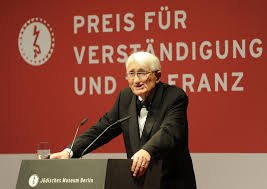
Jürgen Habermas, born in 1929, stands as one of the most influential philosophers and social theorists of the 20th and 21st centuries. His work, deeply rooted in the traditions of critical theory, has profoundly shaped our understanding of communication, rationality, and the public sphere. This exploration delves into the core tenets of Habermas’s thought, his lasting impact, and why his ideas remain remarkably relevant in today’s complex world.
The Foundations of Communicative Rationality
At the heart of Habermas’s philosophy lies the concept of communicative rationality. He challenged the traditional, instrumental rationality – focused on efficiency and control – arguing that true rationality resides in the pursuit of mutual understanding through open and reasoned dialogue. This isn’t simply about agreeing; it’s about reaching a consensus based on the ‘unforced force of the better argument.’ Habermas believed that when individuals engage in communication free from coercion and manipulation, they can arrive at truths that are more legitimate and binding than those imposed by power structures.
This idea is a direct response to the perceived failures of the Enlightenment project. While acknowledging the Enlightenment’s emphasis on reason, Habermas critiqued its tendency towards a purely technical and instrumental view of the world. He sought to reclaim a more nuanced understanding of reason, one that prioritizes intersubjective understanding and ethical considerations. His work builds upon the foundations laid by thinkers like Kant and Hegel, but moves beyond them to address the challenges of modernity.
The Public Sphere and Democratic Discourse
Perhaps Habermas is best known for his theory of the public sphere, outlined in his seminal work, “The Structural Transformation of the Public Sphere” (1962). He described the public sphere as a realm of social life where individuals can come together to freely discuss and identify societal problems, and thereby influence political action. Historically, this sphere manifested in spaces like coffee houses, salons, and literary societies.
Crucially, Habermas argued that the public sphere must be accessible to all citizens, free from domination by private interests or the state. He observed a decline in the quality of the public sphere in the 20th century, attributing it to the rise of mass media, commercialization, and the increasing influence of public relations. These factors, he argued, have led to a more fragmented and manipulated public opinion, hindering genuine democratic discourse. You can find further analysis of the public sphere’s evolution at Stanford Encyclopedia of Philosophy.
Habermas’s Later Work and Continuing Relevance
Habermas continued to develop his ideas throughout his career, addressing issues of law, morality, and political legitimacy. His work on discourse ethics proposes a procedural approach to moral justification, arguing that norms are valid only if they can be agreed upon by all affected parties in a rational discourse. He also engaged extensively with contemporary political challenges, including the rise of populism and the future of European integration.
Today, Habermas’s theories remain incredibly relevant. In an age of social media, fake news, and political polarization, his insights into the importance of reasoned dialogue, a robust public sphere, and the dangers of manipulation are more crucial than ever. Understanding his work provides a valuable framework for analyzing the challenges facing democratic societies and for envisioning a more just and communicative future. For a deeper dive into his later works, consider exploring resources from the Habermas.org website.



