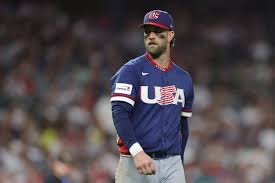
Bryce Harper Champions Baseball’s Return to the Olympics: A 2028 Vision
As special as the World Baseball Classic (WBC) has become, Philadelphia Phillies superstar Bryce Harper believes the 2028 Olympics would provide an even grander stage for baseball. With the Summer Games heading to Los Angeles in 2028, Major League Baseball (MLB) and the Players Association are actively navigating the complexities of sending big league players to the international tournament.
“Obviously, the WBC is great, but it’s not the Olympics,” Harper stated Friday in Houston, where he’s competing for Team USA in the WBC. “That’s no disrespect to the WBC or anything. But everybody knows when the Olympics are on, everybody is watching. Doesn’t matter what sport it is. It could be the most random sport and it has all of the fans watching. I hope L.A. ’28 happens.”
MLB Commissioner Optimistic About 2028 Participation
MLB Commissioner Rob Manfred shares Harper’s enthusiasm. “We’re a lot closer to there than we were the last time we talked about it,” Manfred said last month. “There’s some issues with the MLBPA that we just need to resolve. I sense a lot of momentum towards playing in L.A. in 2028. I think we’re going to get over those issues. I think people have come to appreciate that the Olympics on U.S. soil is a unique marketing opportunity for the game.”
Bruce Meyer, the head of the players’ union, confirmed ongoing discussions. Scheduling is a key consideration, with MLB aiming to integrate the All-Star Game and the Olympics into the existing summer break. Holding the All-Star Game on the West Coast in 2028 is also being considered, with San Francisco emerging as a potential host city, as reported by the San Francisco Standard.
Addressing Insurance and Risk Concerns
A significant hurdle remains: insurance. MLB teams require protection for their investments, and players are understandably hesitant to risk their salaries. The WBC experienced issues with insurance coverage, a problem that could be amplified for the Olympics. Unlike leagues like Japan’s, where insurance hasn’t been a barrier to participation, MLB’s higher player salaries necessitate robust coverage.
Harper acknowledges the concerns, drawing a parallel to hockey. “From an ownership standpoint, I totally get it,” he said. “As players and owners, we have to come to an agreement that works for everybody… understanding that you can get hurt playing during the regular season, you can get hurt playing during the Olympics. There’s nothing like representing your country.”
Financial and Logistical Considerations
Determining who will cover the costs – the league, the union, or the Olympics’ organizing committee – is a crucial part of the negotiations. The comfort level of MLB players staying in the Olympic Village is also under discussion. Furthermore, plans for players not participating in the All-Star Game or Olympics, potentially through exhibition games, are being explored.
MLB has not previously sent a contingent to the Olympics, but the NHL has a history of sending its players to the Winter Games. The NHL’s negotiation process offers a potential timeline, with an agreement for the 2026 Winter Olympics reached in July 2025. Discussions surrounding baseball’s Olympic participation will likely be integrated into the next collective bargaining negotiations.
“I’m hoping the next (collective bargaining) agreement can happen where teams and players can come to an agreement on taking that two-week break, especially it being in our home country,” Harper said. “It would be great for baseball.”
The future of Casey Wasserman, head of the 2028 L.A. games’ organizing effort, is currently uncertain due to the Department of Justice’s disclosure of files related to Jeffrey Epstein. However, Manfred emphasized that MLB’s efforts are focused on the institution of the Olympics, not Wasserman personally.
Source: The Athletic