
html
Beyond Our Stars: The Quest for Interstellar Comet 3I/ATLAS and NASA’s Cosmic Hunt
Imagine an object from another star system, a cosmic wanderer venturing into our own. The universe, vast and mysterious, occasionally sends us messengers from interstellar space. The concept of an interstellar comet like the hypothetical 3I/ATLAS sparks immense excitement among astronomers and space enthusiasts alike. But what would such a discovery entail, and what role does NASA play in this cosmic hunt?
The Allure of Interstellar Visitors: ‘Oumuamua and Borisov
Our solar system has only recently confirmed its first two interstellar visitors: 1I/’Oumuamua in 2017 and 2I/Borisov in 2019. These pioneering objects provided invaluable, albeit brief, glimpses into the chemistry and physics of other star systems. ‘Oumuamua, a peculiar cigar-shaped object, defied easy categorization, while Borisov was a more traditional comet, albeit one with an exotic origin.
The discovery of these ‘I’ designated objects (with ‘I’ standing for interstellar) opened a new frontier in astronomy, inspiring a fervent global search for the next wanderer. The possibility of discovering a 3I/ATLAS represents the ongoing hope of unraveling more secrets of our galactic neighbourhood.
What Would a “3I/ATLAS” Mean?
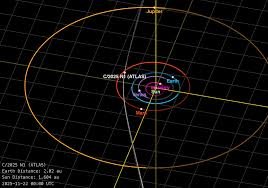
The designation 3I/ATLAS suggests a third confirmed interstellar object, potentially discovered by the Asteroid Terrestrial-impact Last Alert System (ATLAS) surveys. While there hasn’t been a confirmed 3I/ATLAS as of yet, the name embodies the aspirations of modern astronomy.
A new interstellar comet would offer unprecedented data, potentially revealing:
- Unique Compositions: Clues about the building blocks of planets and solar systems far beyond our own.
- Formation Environments: Insights into the diverse conditions under which comets form in other stellar nurseries.
- Interstellar Medium: A deeper understanding of the material that permeates the vast emptiness between stars.
Each new visitor adds a crucial piece to the puzzle of cosmic evolution, helping us understand how common or unique our own solar system might be.
Distinguishing from Comet ATLAS (C/2019 Y4)
It’s important to differentiate the hypothetical interstellar comet 3I/ATLAS from the well-known Comet ATLAS (C/2019 Y4). Comet ATLAS (C/2019 Y4), discovered by the same ATLAS survey, garnered significant attention in early 2020 for its rapid brightening, leading to predictions of it becoming a spectacular naked-eye object. Unfortunately, it famously disintegrated before reaching its peak. Crucially, C/2019 Y4 was a long-period comet originating from our solar system’s Oort Cloud, not an interstellar object. The distinction highlights the precision required in classifying these celestial bodies.
NASA’s Indispensable Role in the Interstellar Hunt
NASA and its global partners are at the forefront of identifying and characterizing interstellar objects. Their contributions are multi-faceted:
- Advanced Telescopes: Instruments like the Hubble Space Telescope and the upcoming Nancy Grace Roman Space Telescope provide high-resolution imaging and spectroscopic analysis. Ground-based observatories worldwide, including those funded or supported by NASA, also play a crucial detection role.
- Data Analysis: Sophisticated algorithms process vast amounts of sky survey data to spot unusual trajectories that signal an object’s non-solar origin.
- Follow-up Observations: Once an interstellar candidate is identified, NASA coordinates rapid follow-up observations to confirm its trajectory and gather vital scientific data before it departs our solar system.
- Mission Planning: Future missions could potentially be designed to intercept or rendezvous with interstellar objects, offering even more detailed study. The Jet Propulsion Laboratory (JPL), a NASA centre, has been instrumental in tracking and analyzing both ‘Oumuamua and Borisov.
The agency’s expertise in celestial mechanics and mission operations is paramount to successfully tracking these fast-moving, elusive visitors.
The Future of Interstellar Discoveries
The quest for the next interstellar visitor, whether it be a 3I/ATLAS or another designated object, is continuous. With advancements in sky-survey technologies and data processing capabilities, the probability of detecting more interstellar objects is increasing. Each detection offers a unique window into the vast diversity of cosmic material beyond our sun, fueling our curiosity and expanding our understanding of the universe we inhabit.



