Asteroid Impact in the North Sea: Unveiling a Tsunami’s Ancient Origins
A long-standing scientific debate surrounding the Silverpit Crater, located beneath the southern North Sea, has finally been resolved. Groundbreaking research confirms that this enigmatic structure formed approximately 43 to 46 million years ago when an asteroid or comet collided with the region. The investigation, spearheaded by Dr. Uisdean Nicholson of Heriot-Watt University in Edinburgh and supported by the Natural Environment Research Council (NERC), provides the clearest evidence yet that Silverpit is one of Earth’s rare impact craters.
A Hidden Crater Beneath the Waves
Silverpit lies roughly 700 meters beneath the seabed, approximately 80 miles off the coast of Yorkshire. Since its initial identification in 2002, the 3-kilometer-wide crater and its surrounding 20 km ring of circular faults have ignited considerable discussion. While initial theories suggested a high-speed asteroid impact – supported by its circular shape, central peak, and concentric faults – alternative explanations emerged.
Some scientists proposed that underground salt movement distorted the rock layers, creating the structure. Others speculated that volcanic activity caused the seabed to collapse. A 2009 geological vote even leaned against the asteroid impact hypothesis, as reported in Geoscientist magazine.
New Seismic Data Confirms the Impact
However, the latest findings dramatically overturn this previous conclusion. Dr. Nicholson’s team analyzed newly acquired seismic imaging and geological samples from beneath the seabed. “New seismic imaging has given us an unprecedented look at the crater,” explains Dr. Nicholson, a sedimentologist at Heriot-Watt University.
Crucially, samples from an oil well revealed rare ‘shocked’ quartz and feldspar crystals at the crater floor’s depth. “We were exceptionally lucky to find these – a real ‘needle-in-a-haystack’ effort,” Dr. Nicholson states. “These prove the impact crater hypothesis beyond doubt, because they have a fabric that can only be created by extreme shock pressures.” These microscopic minerals form exclusively under the immense pressures generated during asteroid impacts.
A Tsunami Triggered by the Asteroid
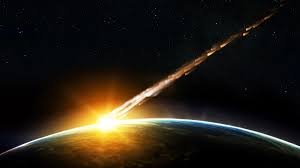
The evidence indicates that an asteroid approximately 160 meters wide struck the seabed at a shallow angle from the west. “Our evidence shows that a 160-meter-wide asteroid hit the seabed at a low angle from the west,” Dr. Nicholson elaborates. “Within minutes, it created a 1.5-kilometer high curtain of rock and water that then collapsed into the sea, creating a tsunami over 100 meters high.” The impact would have unleashed a powerful explosion and sent massive waves radiating across the region.
The “Silver Bullet” and Future Implications
Professor Gareth Collins of Imperial College London, who contributed numerical simulations to the research, remarked, “I always thought that the impact hypothesis was the simplest explanation and most consistent with the observations. It is very rewarding to have finally found the silver bullet.”
Dr. Nicholson emphasizes that Silverpit is a “rare and exceptionally preserved hypervelocity impact crater.” He explains, “These are rare because the Earth is such a dynamic planet – plate tectonics and erosion destroy almost all traces of most of these events.” With around 200 confirmed impact craters on land and only 33 identified beneath the ocean, Silverpit offers a unique opportunity to understand how asteroid impacts have shaped our planet throughout history and to assess potential future collision risks. The crater now stands alongside renowned structures like the Chicxulub Crater in Mexico (linked to the dinosaur extinction) and the recently identified Nadir Crater off the coast of West Africa.
Source: Heriot-Watt University