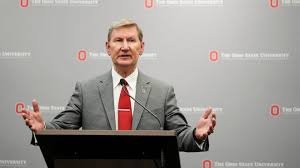
Ted Carter Resigns as Ohio State University President
After a little over two years in office, Ted Carter has resigned from his position as President of Ohio State University following the disclosure of an inappropriate relationship to the Board of Trustees. The resignation, accepted over the weekend, came after a lengthy three-hour executive session of the board on March 7th.
According to a university statement, Carter, 66, informed the trustees prior to the meeting that he had engaged in an inappropriate relationship with an individual “seeking public resources to support her personal business.” He proactively offered his resignation, which the board subsequently accepted.
John Zeiger, Chair of the Ohio State Board of Trustees, expressed the board’s surprise and disappointment in a letter accepting Carter’s resignation. “The Board was surprised and disappointed to learn of this matter and takes the situation and its potential impact on the university very seriously,” Zeiger stated. He further acknowledged Carter’s cooperation in ensuring a smooth leadership transition.
Details Remain Scarce
The university has declined to provide further details regarding the nature of the relationship that prompted Carter’s resignation. This lack of transparency has fueled speculation, but officials have maintained a tight-lipped stance.
A Short Tenure Marked by Progress
Despite the abrupt ending, Carter’s tenure was largely viewed positively. Trustees consistently praised his steady leadership and his role as an advocate for the university’s land-grant mission. In August, he received a 4.5% merit raise, increasing his base salary to $1,189,733, along with a substantial $398,475 bonus.
In a statement to the campus community, Carter acknowledged his mistake, stating, “I made a mistake in allowing inappropriate access to Ohio State leadership.” He expressed regret at not being able to continue serving as president, highlighting the progress made during his time at the university and the promising future outlined in the Education for Citizenship 2035 strategic plan.
Looking Ahead: Transition and Uncertainty
Carter’s departure marks the second time in just over a year that Ohio State has faced a presidential resignation. His predecessor, Kristina Johnson, stepped down in May 2023, citing concerns with the Board of Trustees. Carter’s initial contract was set to run through December 31, 2028.
Prior to Ohio State, Carter served as president of the University of Nebraska system. His career was largely defined by his distinguished service in the United States Navy, where he graduated from the U.S. Naval Academy and completed training at Top Gun and Navy Nuclear Power School. He also held leadership positions at the Naval War College and the Armed Forces Staff College.
During his first year at Ohio State, Carter embarked on a comprehensive “listening and learning” tour, engaging with students, faculty, and staff to develop his 10-year strategic plan, Education for Citizenship 2035. This plan included initiatives such as new scholarships, investments in key colleges, an AI Fluency initiative, and a $100 million effort to attract top faculty.
The university has not yet announced an interim president. Zeiger assured the campus community that a transition plan would be shared shortly, emphasizing the university’s continued commitment to excellence. He called on all members of the Ohio State community to support the university during this period of change.
Stay updated: For more information, you can follow higher education reporter Sheridan Hendrix on Twitter and Instagram.