
Criminal Attorney Acquitted: A High-Stakes Legal Battle at Portland Airport
In a compelling victory for legal defense and individual rights, a Multnomah County jury has once again acquitted prominent criminal attorney Ernest Clarke Zacher of trespass charges. This marks the second time in two months that jurors rejected the prosecution’s claims, turning a seemingly straightforward airport incident into a profound discussion on police authority, probable cause, and the unwavering resolve of a seasoned defense lawyer.
The case, which captivated legal observers, unfolded with all the drama of a courtroom thriller, pitting an intoxicated Zacher against Port of Portland police officers. The heart of the dispute? Zacher’s refusal to leave the Portland International Airport after being denied boarding for a flight.
The Tumultuous Airport Encounter Unfolds
The incident began just before midnight on July 12th, when Zacher, after consuming several hard seltzer drinks, arrived at Portland International Airport (PDX). He was scheduled for a first-class flight, but airline staff flagged him as a “yellow light” concern due to belligerent behavior, rudeness, and pounding on the counter. His boarding pass was confiscated, and he was denied entry to the boarding ramp.
Initially, Zacher believed United Airlines staff would rebook him. However, circumstances escalated when a representative decided against rebooking and contacted airport police. This pivotal moment set the stage for a dramatic confrontation that would soon test the boundaries of legal authority.
A Clash of Authorities: “We Run the Show”
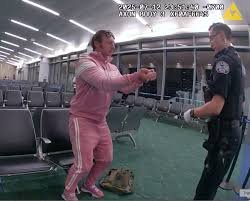
Upon the arrival of Officers Colby Wilkie and Marinna Ordiway, Zacher, who was visibly intoxicated, invoked his right to remain silent. When Officer Wilkie demanded his ID, Zacher refused, arguing that the police lacked probable cause for such a demand. His declaration – “I am a criminal defense attorney. I know how this works and you don’t have probable cause” – was met with a dismissive retort from Officer Ordiway: “We don’t care. We run the show.”
This exchange, captured on body camera footage, became a central point of contention. Zacher, remaining seated, was ultimately given the choice to leave or face arrest. He chose the latter, leading to his handcuffing and subsequent arrest for second-degree criminal trespass. Officer Ordiway, recognizing Zacher from court, even quipped that he “should know better.”
The Battle in the Courtroom: A Defense Lawyer’s Fight for Justice
The legal saga commenced, highlighting the tenacity required in criminal defense. Deputy District Attorney Eric Pickard argued that Zacher’s choice to be arrested proved his guilt, asserting, “Nobody is above the law.” Pickard emphasized that Zacher no longer had authorization to be in the TSA-screened area of the airport.
Defense vs. Prosecution: Legal Showdown
Zacher’s legal team, led by Alexandra A. Eason and Edward LeClaire, mounted a robust defense. They contended that the state failed to prove Zacher knew he was trespassing, arguing he genuinely believed the airline intended to rebook him. Eason passionately stated, “In his heart of hearts, he believed he had a legitimate reason to remain there.”
Furthermore, the defense raised serious allegations of malicious prosecution, suggesting that the decision to retry Zacher (after an initial hung jury in October) was vindictive. They characterized Zacher as a “zealous” defense attorney who had repeatedly bested Pickard in prior trials. While a judge quickly rejected the malicious prosecution claim, the defense successfully painted a picture of an immediate escalation by Officer Wilkie and a failure to provide Zacher with adequate notice of expulsion.
Justice Served? The Verdict
After a three-day trial and four hours of deliberation, a six-person Multnomah County jury delivered its verdict: not guilty. This acquittal not only vindicated Zacher but also underscored the jury’s scrutiny of the prosecution’s burden to prove intent in trespass law.
Despite the district attorney’s office expressing disappointment, they respected the verdict. The case serves as a powerful reminder of the intricate balance between law enforcement authority and individual rights, particularly when those individuals are knowledgeable about the justice system.
Beyond the Verdict: The Aftermath
Following his arrest, Zacher, with the help of friends, managed to book another first-class flight out of PDX the very next day. His ultimate destination was a two-week National Criminal Defense College trial practice training institute – a testament to his dedication as a criminal defense attorney.
His acquittal also brings the hope of regaining his special courthouse pass, which had been revoked during his pretrial release, allowing him to bypass security lines. This victory is not just personal for Zacher; it resonates within the legal community as a significant instance where a defendant, armed with legal knowledge, successfully challenged perceived overreach and secured his freedom.
The case of Ernest Clarke Zacher will likely be remembered as a compelling example of courtroom drama and the enduring importance of a strong legal defense in the American justice system. It prompts reflection on police conduct, the interpretation of law, and the fundamental right of every individual to challenge authority when they believe it exceeds its bounds.



