
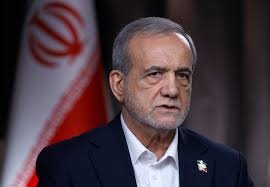
Iranian President Masoud Pezeshkian Signals Potential De-escalation, But Attacks Continue
In a surprising development, Iranian President Masoud Pezeshkian announced that Tehran would halt attacks on its Gulf neighbors under specific conditions. However, this statement was almost immediately overshadowed by reports of renewed strikes, casting doubt on the sincerity or enforceability of the proposed de-escalation. This comes on the one-week anniversary of the strikes that led to the death of Supreme Leader Ali Khamenei, carried out by the United States and Israel.
A Conditional Halt to Attacks
Pezeshkian stated that the decision to cease attacks was made on Friday, contingent on the absence of strikes originating from the territories of Gulf Arab states. Despite this announcement, Iran launched a significant barrage of projectiles on Saturday morning, including 16 ballistic missiles and 121 drones targeting the United Arab Emirates alone. This demonstrates a complex and potentially fractured command structure within Iran’s military apparatus.
An Apology and a Pattern of Regret
In what is being described as the highest-level de-escalatory comment from Iran to date, Pezeshkian offered an apology to neighboring countries for the recent strikes that have caused widespread panic. This apology aligns with a pattern established by the reformist leader, who has repeatedly expressed regret – for the economic downturn, the loss of life during protests, and the inefficiencies of his own administration. This willingness to publicly acknowledge shortcomings is a notable departure from previous Iranian leadership styles.
Internal Divisions and the Role of the IRGC
The situation is further complicated by questions surrounding the alignment between Pezeshkian’s pronouncements and the goals of the armed forces, particularly the powerful Islamic Revolutionary Guard Corps (IRGC). The IRGC has historically operated with a degree of autonomy, initiating its own measures in response to perceived threats. Pezeshkian’s membership in the Leadership Council, formed after the US-Israeli strikes, doesn’t necessarily guarantee control over military actions.
International Reactions and Escalating Rhetoric
While Pezeshkian’s comments were met with relief in Gulf Arab states, the continued attacks raise serious concerns. US President Donald Trump responded to the announcement with skepticism, claiming Iran had “surrendered” and warning of “complete destruction” for areas of the country under consideration for attack. Iran’s army, in turn, vowed “crushing and severe strikes” against US and Israeli military interests in the region if offensive actions continue. The Council on Foreign Relations provides in-depth analysis of the region’s geopolitical landscape.
A Leadership Vacuum and Uncertain Future
Pezeshkian’s leadership is occurring during a period of significant instability and uncertainty. The Leadership Council, comprised of Pezeshkian, Ayatollah Alireza Arefi, and Gholamhossein Mohseni Ejei, is tasked with managing the country’s affairs until a successor to Khamenei is chosen. Meanwhile, the Iranian army has become increasingly independent and isolated, operating with limited oversight. Even Oman, a key mediator, has been impacted by Iranian projectiles, highlighting the widespread instability.
The Complex Process of Selecting a New Supreme Leader
The selection of a new Supreme Leader is a confidential and complex process, restricted to clerics within the Assembly of Experts. This procedure has only been followed once before, following the death of Ayatollah Ruhollah Khomeini. The Islamic Republic recognizes the existential crisis it faces and is proceeding with extreme caution in selecting its next leader. The speed with which Khamenei was chosen after Khomeini’s death – within 24 hours – may not be replicated given the current volatile situation.



