
Dick Cheney’s Funeral: A Stark Look at America’s Deepening Political Fault Lines
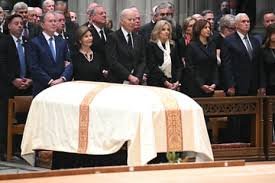
The recent funeral service for former Vice President Dick Cheney, a formidable figure in the Republican Party and a defense hawk, provided a revealing snapshot of the current state of US politics. Held at the revered National Cathedral in Washington D.C., the event was marked not just by who was present, but perhaps even more so by the notable absences and calculated snubs.
While President Joe Biden and former President George W. Bush were among the distinguished attendees, signaling a bipartisan respect for the late vice president, two prominent figures were conspicuously missing: former Presidents Barack Obama and Bill Clinton. A spokesperson for Clinton cited an unavoidable scheduling conflict, but the reasons for other high-profile exclusions ran deeper into the nation’s political schisms.
A Gathering of Old-School Republicans and Bipartisan Respect
The service was a testament to Cheney’s enduring legacy among a certain generation of political leaders. Former President George W. Bush delivered a poignant eulogy, sidestepping any mention of past power dynamics and instead praising Cheney as an exceptional second-in-command. “They don’t come any better than Dick Cheney,” Bush stated, highlighting the trust and capability Cheney brought to the office.
The front pews were a fascinating mix of political affiliations, underscoring moments of bipartisan unity that sometimes transcend partisan divides. Alongside President Joe Biden, attendees included Vice President Kamala Harris, former Vice Presidents Mike Pence, Al Gore, and Dan Quayle, former House Speaker Nancy Pelosi, and Supreme Court Chief Justice John Roberts. This diverse gathering spoke volumes about the respect Cheney commanded across the political spectrum, despite his often-polarizing public image.
The Trump Snub and the Cheney Family’s Stance
Perhaps the most talked-about absence was that of former President Donald Trump, alongside Senator JD Vance. A White House official confirmed they were not invited to the solemn occasion. Trump’s exclusion, however, came as little surprise to political observers, given his increasingly strained relationship with the Cheney family, particularly with Dick Cheney’s daughter, Liz Cheney.
Liz Cheney, a former Republican congresswoman, became a vocal critic of Trump following the January 6th Capitol riot. Her prominent role as vice-chair of the House committee investigating the insurrection deeply angered Trump, who subsequently endorsed her primary challenger in the 2022 midterms. The Cheney family’s ideological break with the Trump-era Republican Party was further highlighted when both Dick and Liz Cheney endorsed Kamala Harris in the 2024 election, a move that would have been unthinkable during Dick Cheney’s vice presidency.
Liz Cheney’s Powerful Testament to Duty
Liz Cheney herself spoke at the funeral, offering a powerful reflection on her father’s commitment to public service and the American republic. Without directly attacking the current president, she drew a clear connection between her father’s principles and her own decision to hold Donald Trump accountable for the events of January 6th. She asserted that defending the Constitution must always supersede party loyalty, a core tenet she learned from her father, who, despite being a staunch Republican, was inspired by Democratic President John F. Kennedy to enter public service.
Her words echoed her father’s long-held belief that “the bonds of party must always yield to the single bond we share as Americans. For him, a choice between defense of the constitution and defense of your political party was no choice at all.” This message resonated deeply, particularly in an era marked by intense political polarization.
Dick Cheney’s Enduring Legacy
Often dubbed one of the most polarizing vice presidents in U.S. history, Dick Cheney passed away at 84 due to complications from pneumonia and cardiac and vascular disease. His extensive career in Washington began at the age of 28 in the Nixon administration, rising to become the youngest White House chief of staff at 34. He served a decade in the U.S. House of Representatives, where he became House minority whip, before serving as Defense Secretary under George H.W. Bush, overseeing the Gulf War operations.
As Vice President to George W. Bush, Cheney played a pivotal role in shaping the U.S. response to the 9/11 terrorist attacks, advocating for expanded government surveillance powers and leading the charge for the invasions of Iraq and Afghanistan. His influence profoundly shaped American foreign and domestic policy for decades.
A Mirror to Modern American Politics
Dick Cheney’s funeral served as more than just a memorial; it was a potent symbol of the profound transformations and ideological chasms within American politics today. The presence of some, the absence of others, and the powerful words shared by his daughter all underscored a continuing struggle for the soul of the Republican Party and the broader principles of American governance. It was a moment where personal grief intertwined with national political drama, offering a rare, unvarnished look at the evolving landscape of power and principle in Washington.



