
Bahrain: Rising Tensions and US Military Buildup in the Middle East
Amidst growing concerns over potential conflict, the United States is taking decisive action in the Middle East. Recent developments, including the repositioning of U.S. Air Force assets and a call for American citizens to leave Israel, signal a heightened state of alert as the threat of a strike on Iran looms larger. President Trump has deployed two carrier strike groups to the region, while simultaneously expressing skepticism about Iran’s commitment to abandoning its nuclear program.
Strategic Asset Repositioning
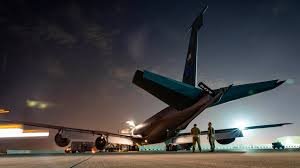
Satellite imagery reveals a significant shift in U.S. military positioning. Aerial refueling aircraft previously stationed at Al Udeid Air Base in Qatar have been relocated. While the base still hosts C-17A Globemaster III transports – likely supporting contingency preparations – the departure of KC-135 Stratotanker aircraft suggests a proactive measure to protect high-value assets. C-130 Hercules transports indicate continued special operations activity.
This move mirrors past strategies employed before major U.S. operations, as seen last year. Currently, dozens of KC-46 Pegasus and KC-135 refueling aircraft are strategically positioned across Europe and the Middle East, including at Ben Gurion International Airport in Israel. Over a dozen U.S. refuelers have arrived at Ben Gurion in the past week, bolstering the region’s aerial refueling capabilities.
Evacuation Orders and Diplomatic Efforts
The U.S. Department of State has urged American citizens to “consider leaving Israel while commercial flights are available” and authorized the departure of non-emergency personnel and their families due to safety concerns. U.S. Ambassador to Israel, Mike Huckabee, emphasized the urgency, advising non-essential embassy staff to depart immediately. This echoes a similar evacuation order issued before Operation Midnight Hammer, the U.S. strikes on Iranian nuclear facilities last year.
Other nations, including the UK, have also begun withdrawing staff from their embassies in Iran, further highlighting the escalating tensions. Simultaneously, diplomatic efforts continue, with recent discussions between the U.S. and Iran in Geneva proving inconclusive. Key negotiators, Steve Witkoff and Jared Kushner, have yet to issue a statement.
Military Buildup and Regional Presence
The U.S. military presence in the region is rapidly expanding. The aircraft carrier USS Gerald R. Ford, accompanied by its strike group, is en route to the coast of Israel, joining the USS Abraham Lincoln already positioned south of Iran. This naval force represents the largest concentration of ships in the Middle East since the 2003 invasion of Iraq, according to the Center for Strategic and International Studies (CSIS).
Air Force assets are also being deployed. F-35A stealth jets and F-15E Strike Eagles have arrived at RAF Lakenheath in England, serving as a staging point for potential deployment to the Middle East. Additionally, 11 F-22A Raptor jets are now stationed at Ovda Air Force Base in Israel, with more arriving at Lakenheath. Approximately 30 F-35As are already deployed to Muwaffaq Salti Air Base in Jordan, alongside F-15Es, F-16s, and A-10s. F-16s are also deployed to Diego Garcia in the Indian Ocean.
Negotiations and Potential Outcomes
A major sticking point in negotiations remains Iran’s refusal to fully comply with U.S. demands regarding its nuclear program, including relinquishing its enriched uranium stockpile and abandoning its right to domestic enrichment. However, Omani Foreign Minister Badr Albusaidi, a key mediator, suggests “substantial progress” has been made, with Iran agreeing to prevent the creation of nuclear weapons and allowing full access for UN inspectors.
President Trump, while expressing dissatisfaction with the negotiations, acknowledges the possibility of military action, stating that it is sometimes necessary. Albusaidi is currently in Washington, attempting to persuade the Trump administration to avoid military intervention.
Despite the increased military presence, experts note that current assets may not be sufficient for a prolonged air campaign, though the inclusion of the Israeli Air Force could alter this assessment.
Sources:



