
html
The Latest Chapter: Unpacking the Epstein Scandal’s Demand for Transparency
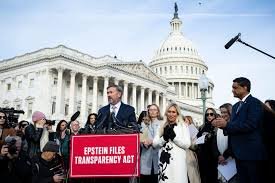
The seismic shockwaves from Congress’s unified demand for full transparency into the Jeffrey Epstein scandal continue to reverberate, shifting the narrative from past drama to an urgent quest for accountability. Yet, as the dust settles, a cloud of uncertainty looms: Will the executive branch truly comply, or will President Donald Trump attempt to sidestep this unprecedented political pressure?
For the victims of Epstein, an accused sex trafficker whose crimes tragically saw justice postponed before, the initial euphoria of a congressional triumph quickly gave way to a hardened wisdom. They understand that legislative victories are merely steps in a protracted battle for vindication, a truth that becomes strikingly clear as Washington grapples with the fallout of this **latest** development.
An Unprecedented Congressional Mandate for Disclosure
After a day of anxious anticipation, President Trump finally signed the bill requiring the Justice Department (DOJ) to release all investigative files, documents, and related materials concerning Epstein within 30 days of its enactment. This landmark legislation, passed with overwhelming bipartisan support—a staggering 427-1 in the House and unanimous consent in the Senate—represents a forceful repudiation of any attempt to keep the evidence secret.
The president, cornered by congressional majorities that signaled a likely override of any veto, was compelled to act. However, the critical question now is the extent of the DOJ’s compliance. Any perceived foot-dragging or obstruction would inevitably worsen public disapproval of the administration’s handling of the issue and intensify the very question that ignited this crisis: What is being hidden?
Trump’s Dilemma and the DOJ’s Precarious Position
With the bill now law, the DOJ is, in theory, bound to implement it. Yet, the department’s reputation, often perceived as an extension of the political machine, casts a long shadow over expectations. Attorney General Pam Bondi’s flustered public performance has done little to instill confidence that the administration has a coherent plan for obeying Congress, or that it intends to adhere strictly to the letter of the law.
Epstein survivors and administration critics are steeling themselves for the next phase of this political battle, navigating a landscape with almost no clarity on if, when, and how much evidence will actually surface. Lawmakers themselves seemed uncertain about the repercussions if the administration simply ignored the mandate, highlighting the delicate balance of power at play.
Wider Repercussions: A Web of Connections Unraveling
Beyond the immediate political skirmish, the Epstein scandal continues to unveil deeper, bipartisan morasses. The release of DOJ files could cause significant embarrassment for a broad spectrum of prominent figures, including:
- Business and Political Leaders: Many associated with Epstein could face public scrutiny.
- Entertainment Stars and Royalty: The notorious circles Epstein moved in suggest a far-reaching impact.
Elite Connections Under Scrutiny
Recent developments underscore this uncomfortable truth. Larry Summers, a former Treasury Secretary and high-ranking White House official in Democratic administrations, resigned from the board of OpenAI and will not finish his teaching semester at Harvard University after emails revealed friendly correspondence with Epstein.
Political Figures Under Scrutiny
Similarly, Stacey Plaskett, a Democratic non-voting delegate representing the U.S. Virgin Islands in Congress, struggled to provide a convincing explanation for texting with Epstein during a 2019 congressional hearing. These incidents are just a glimpse into the potential scope of revelations.
Political Divisions and Public Outcry
The profound implications of this scandal extend far beyond the immediate demand for files. It has undeniably inflicted significant damage on former President Trump’s public standing and, remarkably, exposed an unprecedented rift within the MAGA movement itself.
A recent Marquette University poll, conducted before many of the saga’s **latest** developments, found a staggering 74% of adults disapproved of Trump’s handling of the Epstein affair, with only 43% of Republicans expressing approval. While Epstein wasn’t listed as a top issue, the public’s deep concern over the economy, an area where Trump received overwhelmingly negative feedback, suggests a broader erosion of trust.
Democratic Leaders Demand Accountability
Senate Democratic Leader Chuck Schumer has issued a stern warning, asserting his party’s readiness to hold Trump accountable. He believes the political exposure from the Epstein drama will outweigh any potential embarrassment for prominent Democrats. “There must be no funny business from Donald Trump,” Schumer declared. “This bill is a command for the president to be fully transparent, to come fully clean, and to provide full honesty to the American people, even if he doesn’t want to.”
Schumer also highlighted potential end-runs around the bill, such as citing investigations into prominent Democrats (ordered by Trump last week) as grounds to argue against evidence release, or releasing heavily redacted files that render them almost meaningless under the guise of protecting victims or witnesses.
Republican Rebellion and Congressional Oversight
The Republican rebellion against Trump on the Epstein files, an issue that deeply concerns parts of the Republican base, is noteworthy. However, it remains unclear whether GOP lawmakers will risk the kind of vigorous oversight they’ve historically avoided with Trump to ensure compliance. Pressure from Epstein victims will likely be crucial in pushing for continued scrutiny.
Senators from both parties expressed hope for good faith from the administration. Missouri Republican Sen. Josh Hawley voiced surprise if the DOJ refused to release the required information, given the bipartisan support. Democratic Sen. Dick Durbin of Illinois echoed this sentiment, hoping Trump wouldn’t “defy the act of Congress.”
The Path Forward: Scrutiny and Speculation
The great unknowns surrounding the implementation of this transparency mandate persist. While Bondi has repeatedly stated, “We will follow the law… while protecting victims and also providing maximum transparency,” her earlier comments on the lack of new probe necessity, contrasted with her later agreement to investigate Democrats over Epstein, raise questions about the administration’s true intentions.
Given the extraordinary turns in this saga, it seems inevitable that the files will, somehow, eventually emerge. Should the administration stall or obstruct, the possibility of DOJ whistleblowers coming forward remains a potent threat. Furthermore, Republican lawmakers, keen to position themselves ahead of midterm elections, might find a political motive to join calls for full transparency, echoing figures like Rep. Marjorie Taylor Greene and Rep. Thomas Massie.
The survivors of Epstein’s abuse remain at the heart of this unfolding drama. As Sharlene Rochard, one of Epstein’s victims, powerfully articulated to CNN, “I’m hoping that they’re going to do the right thing and release everything. We just want proof that this happened to us… And we want to help other girls so that this doesn’t happen again.” Their unwavering quest for truth and prevention underscores the profound stakes of this **latest** chapter in the Jeffrey Epstein scandal.



