Dimorphos: How a Strategic Space Collision is Shielding Earth from Future Asteroids
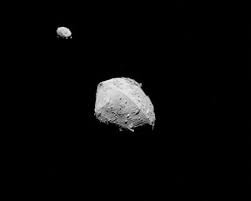
The Blueprint for Planetary Defence: Lessons from Dimorphos
While we aren’t yet facing a galactic fleet of destroyers, humanity is making massive strides in ensuring we don’t meet the same fate as the dinosaurs. Four years after a historic celestial collision, new data from the asteroid Dimorphos is providing scientists with a masterclass in planetary defence.
In a bold experiment, NASA deliberately crashed a spacecraft into Dimorphos, a 160-metre-wide asteroid, to see if we could knock a space rock off course. Now, the European Space Agency (ESA) is revealing the aftermath, and the results are more surprising than anyone expected.
The DART Impact: A Success in Motion
On September 26, 2022, the Double Asteroid Redirection Test (DART) spacecraft slammed into Dimorphos at over 13,000 mph. The goal was simple: change its orbit. The result? A resounding success. Telescopes confirmed that the impact shortened Dimorphos’s orbit around its larger companion, Didymos, by approximately 33 minutes—far exceeding the minimum success threshold of 73 seconds.
Hera’s Revelations: Chaos and Craters
While DART proved we could move an asteroid, the ESA Hera mission was launched to understand exactly what happened upon impact. After a two-year journey, Hera has provided breathtaking close-up images that have left researchers stunned.
The most striking findings include:
- A Stadium-Sized Scar: One face of Dimorphos has been completely flattened, leaving an impact crater comparable in size to a professional sports stadium.
- Chaotic Rotation: Rather than a steady spin, the asteroid is now “tumbling wildly” in its orbit.
- A Ring of Debris: Scientists discovered hundreds of previously unknown boulders, just a few metres wide, encircling both Dimorphos and Didymos.
Why This Matters for Earth’s Survival
Understanding the physics of this impact is crucial. As Dr. Michaël Marsset from the European Southern Observatory notes, knowing the precise mass and velocity of the projectile allows scientists to study asteroid physics with unprecedented accuracy.
The composition of asteroids varies wildly—some are solid masses of rock, while others are “rubble piles” held together by weak gravity. To deflect a potential threat effectively, we need to know exactly what we are hitting. The images from Hera allow for more accurate calculations, turning a one-off experiment into a reliable planetary defence tool.
The Next Frontier: Early Detection
Deflection is only half the battle; the other half is detection. A tiny change in velocity can cause an asteroid to miss Earth entirely, but only if we have years or decades of warning. To solve this, the scientific community is looking toward:
- The Vera C Rubin Observatory: A powerhouse in Chile designed to map the sky with extreme precision.
- NASA’s NEO Surveyor: A dedicated space telescope tasked with hunting Near-Earth Objects.
By combining the impact data from Dimorphos with advanced detection technology, humanity is finally moving from a state of vulnerability to a state of preparation. We may not be able to stop a Vogon fleet, but we are well on our way to mastering the art of asteroid deflection.
📰 You May Also Like