NASA’s Voyager 1: A Historic Milestone Marred by a Mysterious Data Glitch
A Bittersweet Milestone in the Deep Void
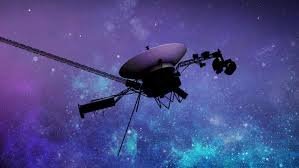
In a poetic twist of cosmic timing, NASA’s Voyager 1—the farthest human-made object in existence—just reached a staggering milestone. For the first time, the probe has traveled one light-day away from Earth. This means a radio signal, traveling at the speed of light, now takes a full 24 hours to reach the spacecraft, covering a distance of roughly 16 billion miles (26 billion kilometers).
However, the celebration was short-lived. Just as it touched this invisible boundary, the aging spacecraft experienced a critical Voyager 1 data glitch, leaving NASA engineers in a race against time and distance.
The Silence of the Science: What Went Wrong?
Currently, Voyager 1 is sending what engineers call a “carrier signal.” Imagine this as the probe saying, “I’m still here and I’m pointed in the right direction,” but without actually delivering any of the science or engineering data that makes the mission valuable. It is effectively a phone call where you can hear the dial tone, but the person on the other end isn’t speaking.
According to NASA’s official mission data, the problem likely resides in an onboard computer responsible for collecting information from the probe’s scientific instruments. Of the ten original instruments, only two are still operational to conserve dwindling power.
The Logistics of a 48-Hour Conversation
Fixing a NASA data glitch at this distance is a painstaking process. Because of the one light-day gap, communication is incredibly slow:
- Command Sent: Takes 24 hours to reach Voyager 1.
- Response Received: Takes another 24 hours to travel back to Earth.
This means every single attempt to troubleshoot the system takes at least two full days to yield a result.
A History of Cosmic Resilience
This isn’t the first time Voyager 1 has flirted with silence. On November 14, 2023, a strikingly similar malfunction occurred. In that instance, NASA identified a failure in a single chip within the Flight Data Subsystem (FDS).
To solve it, engineers performed a digital “surgery,” bypassing the broken chip and redistributing the code across the remaining memory. While NASA hasn’t officially confirmed that the FDS is the culprit this time, the evidence strongly suggests a recurring struggle with the probe’s 49-year-old hardware.
Running on Borrowed Time
Launched in September 1977, Voyager 1 was originally designed for a five-year mission to explore Jupiter and Saturn. Now, nearly five decades later, it is venturing through the interstellar space, having left the heliosphere back in 2012.
Recent incidents—including a total communication blackout in October—serve as a poignant reminder that the probe is operating on borrowed time. While mission controllers continue to find creative ways to extend its life, the question remains: how much longer can we listen to the whispers of our farthest emissary?
For more updates on deep-space exploration, stay tuned to the Jet Propulsion Laboratory (JPL), where the brilliant minds managing the Voyager mission are fighting to keep the signal alive.
📰 You May Also Like