Alysa Liu: From Figure Skating Cage to Olympic Freedom
As they hiked the Himalayas in 2023, Alysa Liu and her best friend – Shay Newton – found themselves in a deep, existential debate. Given the option, would you rather come back as a chicken or a cow?
It was an absurd conversation, Liu admits now, but after seven hours of trekking uphill, the pair had reached a point where the absurd felt essential. Deep in reflective mode, they were learning and sharing about each other. The cow or chicken choice felt surprisingly crucial at the time.
Liu firmly believed being a cow was the only sensible answer. Bovines, she argued, enjoyed a leisurely life, with the world serving as their personal buffet.
“The chickens I’ve seen are often confined to cages,” Liu explained. “No thank you. I feel my chances of being reborn as a cow on a hill are much higher. There are a lot of chickens out there, you know?”
Liu’s comment was particularly poignant, as she once lived within a different kind of gilded cage: the world of competitive figure skating.
A Prodigy’s Rise
At 10, she was competing in the Central Pacific Regionals, and by 13, she’d won the US Nationals, becoming the youngest champion in the competition’s history. She defended her title the following year and, at 16, represented the United States at the Beijing Olympics, finishing seventh. Months later, she earned a bronze at the World Championships, only the second American woman to reach the podium since 2006.
Breaking Free
Then, Alysa Liu broke free. Just two weeks after Worlds, she announced her retirement. She embarked on a journey to experience the life she’d missed. There were extraordinary opportunities, like the Himalayan hike, but it was the ordinary moments she cherished: cat food runs that led to gaming cafes, karaoke nights, art classes, psychology courses, getting her driver’s license, seashell hunting, zip-lining, dorm life, oversleeping, and experimenting with hair dye and piercings – a complete immersion in self-discovery.
Liu made both good and bad decisions, but they were all her own. “I thought the only way to explore other things was to leave skating because I felt trapped. In my mind, breaking free meant leaving the sport,” she said. “And it worked.”
A Return on Her Own Terms
Now, Alysa Liu is part of a strong three-woman American figure skating team, offering the US its best Olympic hopes in decades. But this time, when she steps onto the ice in Milano, it will be different.
Alysa Liu will skate free.
It’s hard to imagine anyone or anything containing the 20-year-old Liu. She is authentically herself.
At the Olympic media summit, while other athletes wore perfectly pressed Team USA gear, Liu arrived in a creatively altered T-shirt – a testament to her individuality. She’d taken scissors to it, transforming a basic tee into a unique statement piece.
“I couldn’t change the color, but I could change the shape,” she explained, embodying her approach to life: a refreshing departure from the norm.
Finding Identity
Liu’s journey has been a two-decade search for identity, discovering who she is, not just what she was – a figure skater. She began skating at five, encouraged by her father, Arthur, a political activist who fled China after the Tiananmen Square protests. He built a law practice and a family, and Alysa is the oldest of his five children.
Arthur, though lacking a skating background, recognized Alysa’s talent and dedicated himself to her training. She achieved success, winning Nationals at 13, becoming a beacon of hope for American figure skating. However, she never felt fully in control of her dream.
She skated to programs chosen by her coaches, wore outfits they designed, and followed a rigorous schedule that often felt isolating. She longed for fun and human connection.
Liu is careful to acknowledge her father’s support, not wanting to portray him negatively. She wanted to skate, but questioning what anyone truly wants at a young age is natural, especially when success clashes with normalcy.
Facing Challenges and Returning Stronger
Liu continued to excel, repeating as national champion in 2020. Then came the pandemic. While many missed their routines, Liu found relief in the break. When skating resumed, a growth spurt made her jumps more challenging. She finished fourth at the 2021 Nationals.
In 2022, the FBI alerted her family that they were being targeted by Chinese spies due to her father’s activism and her success. A man had surveilled the family and attempted to obtain her passport information, aiming to intimidate them into not competing in the Beijing Games.
Despite the unsettling situation, Liu competed in the Olympics, finishing seventh. A month later, she won bronze at the World Championships, the first American woman to medal since 2016.
And then, she quit.
Her triumphant return after a three-year hiatus is even more remarkable. She’s back on her own terms, collaborating with her coaches, setting her own schedule, and choosing her own music and costumes.
A New Era of Skating
Freed from the pressure of expectations, Liu has embraced artistic expression. She’s not just an athlete who can land jumps; she’s an artist conveying emotion through her skating. She hopes the audience “feels something, any emotion.”
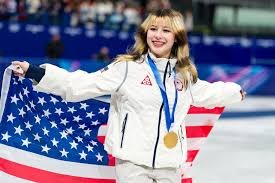
At the 2025 World Championships, Liu skated to Donna Summer’s “MacArthur Park” and won gold, securing the first US victory in nearly two decades.
Now, alongside teammates Amber Glenn and Isabeau Levito, she aims to end a similar drought at the Milan Olympics. An American woman hasn’t won Olympic gold since Sarah Hughes in 2002.
While Glenn is the favorite, Liu’s Olympic experience and Levito’s talent make them strong contenders. But Liu is most excited about the gala – a chance to perform without restrictions, free from judgment.
They are, in essence, freed from their cages.